Supreme Court of India: Jurisdiction, Caseload, Digital Access and Recent Institutional Developments
Supreme Court of India: Jurisdiction, Caseload and Institutional Role
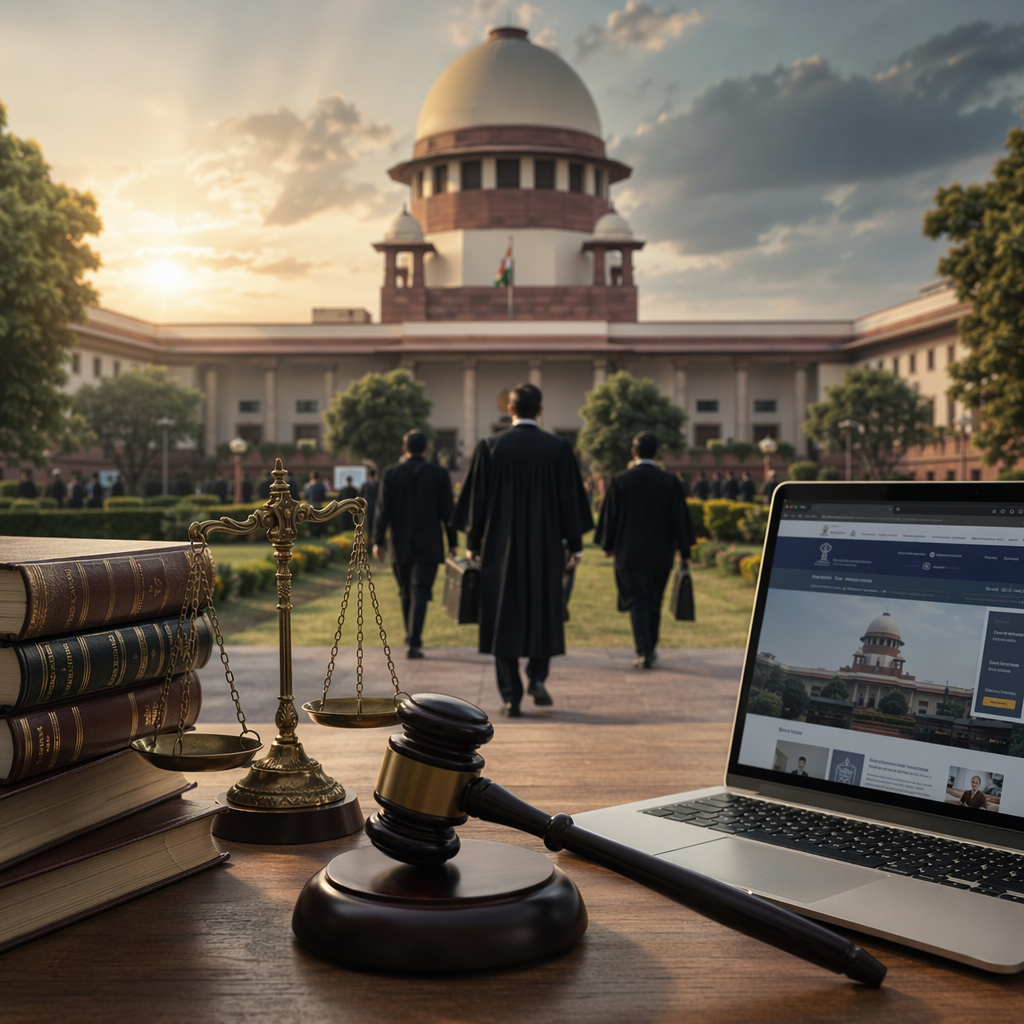
As of 2026, the Supreme Court of India remains the country’s highest constitutional court, with a sanctioned strength of 34 judges, including the Chief Justice of India. According to information available from the Supreme Court of India and the Department of Justice, the Court sits at the apex of a judicial system that includes High Courts in the states and Union territories, and a large network of district and subordinate courts.
The Court’s workload is closely watched because it handles constitutional disputes, civil and criminal appeals, election-related matters, public interest litigation, and questions involving fundamental rights. Government data placed in Parliament and judicial statistics released through official platforms show that pendency across India’s courts remained a major administrative challenge in 2024 and 2025. The National Judicial Data Grid, maintained under the e-Courts project, reported more than 50 million pending cases across Indian courts in 2024, including matters in district courts, High Courts and the Supreme Court.
While the Supreme Court accounts for a small share of total pending cases when compared with the district judiciary, its rulings shape national law. Judgments delivered by the Court are binding on all courts in India under Article 141 of the Constitution. The institution also has a central role in checking executive and legislative action through judicial review.
Constitutional Position and Powers
The Supreme Court of India was established on 28 January 1950, two days after the Constitution came into force. It replaced the Federal Court of India and inherited certain appellate functions from the Judicial Committee of the Privy Council. Its authority flows mainly from Articles 124 to 147 of the Constitution.
The Court has original, appellate and advisory jurisdiction. Under Article 32, individuals can directly approach the Supreme Court for enforcement of fundamental rights. Dr. B.R. Ambedkar described Article 32 during the Constituent Assembly debates as the “heart and soul” of the Constitution, a phrase widely cited in Indian legal writing and judgments.
The Court’s original jurisdiction includes disputes between the Union government and one or more states, or between states. Its appellate jurisdiction covers civil, criminal and constitutional cases from High Courts. The President of India may also seek the Court’s advisory opinion under Article 143, although such opinions are not treated in the same way as binding judgments between parties.
As of 2026, the Supreme Court’s sanctioned judicial strength is 34 judges, a figure set after Parliament increased the number through the Supreme Court (Number of Judges) Amendment Act, 2019. Appointments are made by the President of India after consultation, under the collegium system developed through a series of Supreme Court judgments known as the Judges Cases.
Recent Caseload and Pendency
Case pendency is one of the most frequently cited measurements of judicial capacity in India. In recent years, official dashboards and government replies have shown persistent pressure on courts at all levels. The National Judicial Data Grid, the Department of Justice and the Supreme Court’s own publications have provided periodic updates on the number of matters awaiting disposal.
According to publicly available judicial data, India’s total pending caseload crossed 5 crore cases in 2024. The majority were pending in district and subordinate courts. High Courts accounted for several million more. Supreme Court pendency has remained much smaller in absolute terms, but significant because of the national importance of the matters listed before it.
Reports based on Supreme Court registry data in 2024 placed pending matters in the Court at around 80,000 cases. Government and court-linked data during 2024 and 2025 also showed that the Court disposed of tens of thousands of matters annually, including admission-stage cases, regular hearing matters and miscellaneous petitions.
In 2024, the Court continued to use a combination of regular benches, constitution benches and special benches. Constitution benches, usually made up of five or more judges, hear substantial questions of constitutional interpretation. These benches are important because they can settle conflicting precedents and decide issues that affect large sections of the population.
Key 2024–2026 Statistics
The following figures are drawn from official and publicly available datasets, court information, government releases and widely reported institutional records:
- 34 judges: The sanctioned strength of the Supreme Court of India, including the Chief Justice, as of 2026, following the 2019 statutory increase.
- More than 5 crore pending cases: India’s combined court pendency crossed this level in 2024, according to the National Judicial Data Grid and government references to judicial data.
- About 80,000 Supreme Court matters: Publicly reported Supreme Court pendency in 2024 was around this level, based on registry-linked data and legal reporting.
- 25 High Courts: As of 2026, India has 25 High Courts, which form the tier below the Supreme Court in the constitutional court structure.
- e-Courts Phase III approved in 2023: The Union Cabinet approved the project with a financial outlay of ₹7,210 crore for four years, covering the period into 2027, according to Government of India releases.
- 1950 founding: The Supreme Court began functioning on 28 January 1950, making it more than 75 years old by 2026.
Digital Courts and Public Access
Digitalisation has become a major part of court administration in India. The e-Courts Mission Mode Project, implemented by the Department of Justice in collaboration with the e-Committee of the Supreme Court, aims to improve court infrastructure, case tracking and access to judicial services.
In September 2023, the Union Cabinet approved e-Courts Phase III with an outlay of ₹7,210 crore for four years. The project is scheduled to support digital and paperless court processes, cloud infrastructure, digitisation of records, virtual courts and improved access to case information. The effects of this programme continued into 2024, 2025 and, as of 2026, remain central to India’s judicial technology agenda.
The Supreme Court has also expanded digital access to proceedings. Live-streaming of constitution bench hearings, started in 2022, has continued for matters of broad constitutional importance. The Court provides cause lists, orders and judgments through its official website. The Supreme Court’s e-filing portal allows advocates and parties to file matters electronically, reducing dependence on physical filing.
During and after the COVID-19 pandemic, video-conferencing became a regular part of court functioning. Although physical hearings resumed, hybrid access remained important in several courts. The Supreme Court has repeatedly used technology to allow lawyers to appear from different locations, especially in procedural and short matters.
Major Institutional Developments in 2024 and 2025
In 2024, the Supreme Court delivered several rulings that drew national attention. Reuters reported in February 2024 that the Court struck down India’s electoral bonds scheme, holding that anonymous political funding through the scheme violated voters’ right to information. The ruling directed disclosure of information relating to donors and political parties, leading to public release of data by the Election Commission of India after receiving it from the State Bank of India.
The electoral bonds case was significant because it involved political finance, transparency and constitutional rights. The judgment was delivered by a constitution bench and became one of the most widely reported Indian legal developments of 2024. Reuters, BBC and Indian government-linked public records reported developments following the judgment, including the disclosure process.
In 2024, the Court also heard matters concerning federal relations, criminal law, personal liberty and regulatory powers. As India’s highest appellate court, it regularly handles cases arising from statutes such as the Indian Penal Code, the Code of Criminal Procedure, tax laws, environmental laws and commercial laws. From 1 July 2024, India’s new criminal laws — the Bharatiya Nyaya Sanhita, Bharatiya Nagarik Suraksha Sanhita and Bharatiya Sakshya Adhiniyam — replaced the Indian Penal Code, Code of Criminal Procedure and Indian Evidence Act for new offences and procedures. The transition increased attention on how courts, including the Supreme Court, interpret the new legal framework.
Judicial appointments were also a matter of public record during 2024 and 2025. The collegium system, under which senior judges recommend appointments and transfers, continued to operate. The Department of Justice regularly publishes notifications of judicial appointments after presidential approval. Debate over judicial vacancies, transparency and speed of appointments has been part of parliamentary questions and official discussions, but the formal process remains governed by constitutional provisions and Supreme Court precedents.
Structure of Hearings and Benches
The Supreme Court functions through benches of different sizes. Two-judge and three-judge benches hear most matters. Larger benches are formed when a case involves a substantial question of constitutional law, when earlier judgments require reconsideration, or when a matter has broad legal consequences.
A five-judge bench is commonly referred to as a constitution bench. Larger benches of seven, nine or more judges are formed in cases requiring reconsideration of major precedents. The Chief Justice of India, as master of the roster, assigns cases to benches. This administrative authority has been recognised in Supreme Court judgments and is central to case management.
The Court’s calendar includes regular hearing days and miscellaneous days. Admission matters, special leave petitions and short procedural matters are often listed on miscellaneous days. Regular hearing matters, including final appeals, are taken up on other scheduled days. The Court also operates during limited vacation periods through vacation benches for urgent matters.
Relationship With High Courts and Lower Courts
India’s judicial system is integrated, with the Supreme Court at the top and High Courts supervising state-level judicial systems. As of 2026, India has 25 High Courts. Some High Courts serve more than one state or Union territory. Below them are district and subordinate courts, which handle the bulk of criminal trials, civil suits, family disputes, land matters and local litigation.
High Courts have their own constitutional powers under Article 226, which allows them to issue writs not only for fundamental rights but also for other legal rights. In many cases, litigants first approach High Courts before coming to the Supreme Court through appeal or special leave petition under Article 136.
District courts remain the main point of contact for most citizens. Because the largest share of pending cases is in the district judiciary, national reforms often focus on judge strength, court infrastructure, digital filing, process service and alternative dispute resolution. The Supreme Court’s policy directions, e-Committee work and judgments influence these reforms.
Transparency, Reporting and Public Records
The Supreme Court publishes judgments and daily orders online. It also releases cause lists, case status information and notices. Many hearings of constitutional importance are reported by national and international media, including Reuters and BBC, especially when cases concern elections, civil liberties, business regulation, environmental governance or federal disputes.
Official data on courts is available from the National Judicial Data Grid, the Department of Justice, Supreme Court annual reports and parliamentary answers. These sources help track pendency, disposal, appointments, vacancies and infrastructure funding. However, figures can change daily because new cases are filed and disposed of continuously.
As of 2026, the Court’s public role extends beyond dispute resolution. Its judgments affect election law, privacy, criminal procedure, commercial regulation, environmental protection and the division of powers between the Union and states. Its administrative decisions also influence how courts adopt technology and manage growing caseloads.
Why the Supreme Court Matters in India’s Legal System
The Supreme Court’s importance rests on its constitutional authority. It can invalidate laws that violate the Constitution, protect fundamental rights, settle disputes between governments and interpret statutes that affect national governance. Its decisions bind all Indian courts, which gives its rulings direct legal effect across the country.
The Court also hears special leave petitions under Article 136, a broad discretionary power that allows it to consider appeals from courts and tribunals. This makes the Court accessible in exceptional cases but also contributes to its workload. Managing this balance between constitutional adjudication and appellate review remains a central institutional issue.
In 2024 and 2025, public attention to the Supreme Court was shaped by high-profile constitutional cases, digital access to hearings, political finance litigation and the implementation of new criminal laws. Government data continued to show that pendency across the judicial system remained high, while funding for e-Courts Phase III indicated an ongoing shift toward technology-based court management.
As of 2026, the Supreme Court of India is both a constitutional court and a final appellate court for a country of more than 1.4 billion people. Its capacity, transparency, appointments and case-management systems remain matters of public record and institutional significance, documented through government releases, court data and reporting by established news organisations.
Sources: Reuters, Government releases, publicly available data.
Comments
Post a Comment