Rajinikanth in 2026: Film Career, Public Recognition and the Data Behind a Five-Decade Screen Presence
Rajinikanth in 2026: the numbers behind one of India’s longest-running film careers
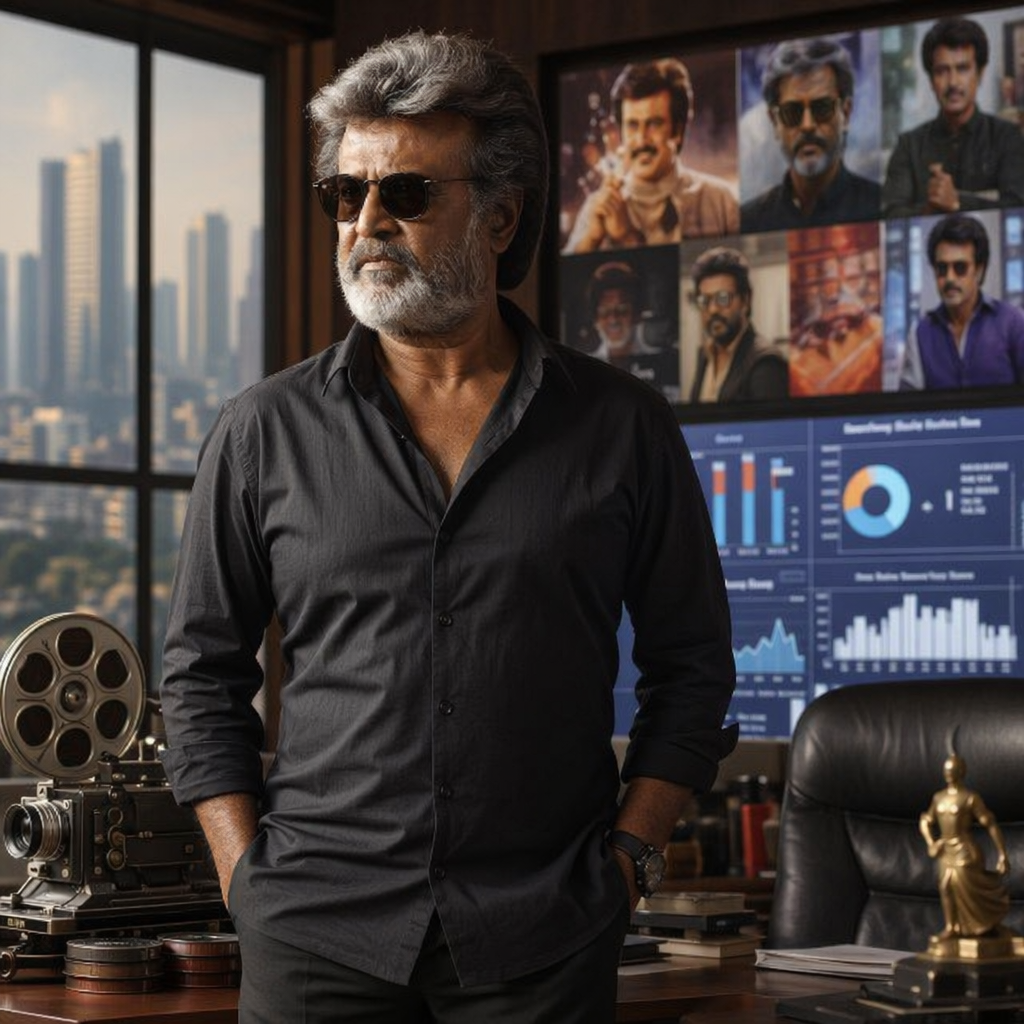
As of 2026, Rajinikanth is 75 years old and has spent more than five decades in Indian cinema, a career span that began with his credited debut in K. Balachander’s Tamil film Apoorva Raagangal in 1975. In a film industry where box-office cycles are increasingly measured by opening weekends, the actor remains commercially active, with recent projects released or announced in the 2024–2026 period and continuing public attention around his film choices.
Rajinikanth, born Shivaji Rao Gaikwad on 12 December 1950 in Bengaluru, is among the most documented figures in South Indian cinema. His public profile extends beyond film: he is a recipient of the Dadasaheb Phalke Award, India’s highest recognition in cinema, and was previously honoured with the Padma Bhushan in 2000 and Padma Vibhushan in 2016, according to Government of India records. His career is closely associated with Tamil cinema, but his releases have been distributed nationally and internationally, particularly across markets with large Tamil-speaking and Indian diaspora populations.
The actor’s continued visibility has been reinforced by recent box-office reporting. According to trade data cited in Indian media and film industry trackers, his 2023 Tamil action film Jailer, produced by Sun Pictures and directed by Nelson Dilipkumar, became one of the highest-grossing Tamil films of that year. Sun Pictures publicly announced in 2023 that the film crossed ₹600 crore in worldwide gross collections. While box-office reporting in India is not centrally audited by a government agency, such producer statements and trade reports remain widely cited by media organisations covering the sector.
Public life and official honours
Rajinikanth’s official recognitions are recorded in government releases and national award documentation. The Dadasaheb Phalke Award for 2019 was conferred on him at the 67th National Film Awards ceremony, held in New Delhi in October 2021 after pandemic-related delays. The Ministry of Information and Broadcasting described the award as the country’s highest honour in cinema.
His national civilian honours also mark his long public profile. The Government of India awarded him the Padma Bhushan in 2000 and the Padma Vibhushan in 2016. The Padma Vibhushan is India’s second-highest civilian award, after the Bharat Ratna. These awards are listed in official Padma Awards records published by the Ministry of Home Affairs.
As of 2026, these honours place Rajinikanth among a small group of Indian film actors who have received both top civilian recognition and the Dadasaheb Phalke Award. The awards are not box-office rankings; they are official recognitions of contribution to the arts and public life.
Recent film activity: 2024 to 2026
Rajinikanth’s recent work shows that he remains professionally active well into his seventies. In February 2024, he appeared in Lal Salaam, a Tamil film directed by Aishwarya Rajinikanth, in which he played an extended cameo role as Moideen Bhai. The film was produced by Lyca Productions and released in theatres on 9 February 2024.
In October 2024, Rajinikanth headlined Vettaiyan, directed by T. J. Gnanavel and produced by Lyca Productions. The film was released on 10 October 2024. Its cast included Amitabh Bachchan, Fahadh Faasil, Rana Daggubati, Manju Warrier and Dushara Vijayan. The project drew national attention because it reunited Rajinikanth and Amitabh Bachchan on screen after several decades; their earlier collaborations included Hindi films such as Andhaa Kaanoon and Hum.
For 2025, Rajinikanth’s major announced project has been Coolie, directed by Lokesh Kanagaraj and produced by Sun Pictures. The title was officially announced in 2024. Sun Pictures released promotional material confirming Rajinikanth’s participation, and the project generated significant coverage because it paired the actor with a filmmaker associated with major commercial Tamil releases such as Vikram and Leo. As of 2026, the production status and release details are subject to official studio announcements.
These projects highlight a measurable fact: between 2024 and 2026, Rajinikanth remained attached to multiple theatrical Tamil film projects, including one released in 2024 as lead actor and another major studio-backed project announced for the following cycle.
Key recent data points
The following publicly reported figures and dates provide a factual snapshot of Rajinikanth’s position in the 2024–2026 period:
- 1950: Rajinikanth was born on 12 December 1950 in Bengaluru; as of 2026, he is 75.
- 1975: He made his credited film debut in Apoorva Raagangal, giving him a cinema career of more than 50 years by 2026.
- 2021: The Government of India presented him with the Dadasaheb Phalke Award for 2019 at the 67th National Film Awards ceremony.
- 2024: Lal Salaam, featuring Rajinikanth in an extended cameo, was released on 9 February 2024.
- 2024: Vettaiyan, starring Rajinikanth, was released on 10 October 2024.
- 2023–2024: Producer Sun Pictures stated that Jailer crossed ₹600 crore worldwide gross after its 2023 release, a figure widely cited in industry coverage during the following year.
Career profile: from supporting roles to lead-star status
Rajinikanth entered cinema through Tamil films under the mentorship of director K. Balachander. His early screen image included supporting and antagonist roles, which later shifted into lead roles across action, drama and mass-entertainment films. His career grew during the late 1970s and 1980s, when Tamil cinema expanded its commercial reach across southern India.
By the 1990s, Rajinikanth had become one of Tamil cinema’s most bankable stars. Films such as Annamalai in 1992, Baashha in 1995 and Padayappa in 1999 became central to his public image. These titles are frequently referenced in film histories and retrospectives as examples of the star-driven Tamil commercial format.
In the 2000s and 2010s, he continued to work with major studios and directors. Sivaji: The Boss in 2007, directed by Shankar, was among the most expensive Indian films of its time, according to contemporary trade reporting. Enthiran in 2010, also directed by Shankar, combined science-fiction themes with large-scale visual effects. Its sequel, 2.0, released in 2018, was produced on a reported large budget and distributed in multiple languages.
The actor’s recent box-office relevance was reinforced by Jailer in 2023. Producer Sun Pictures publicly shared gross collection milestones, and the film’s commercial performance was covered by Indian and international media. Reuters and other agencies have previously reported on the financial scale and international growth of the Indian film industry, including the role of southern Indian language cinema in expanding theatrical returns.
Economic context: Tamil cinema and the Indian film market
Rajinikanth’s career operates inside a rapidly changing Indian media economy. According to the FICCI-EY 2024 media and entertainment report, India’s media and entertainment sector continued to grow after the pandemic disruption, with theatrical cinema recovering through major releases in several languages. The report has identified regional cinema, including Tamil and Telugu films, as a significant contributor to box-office activity.
The Indian film business also draws attention from global platforms and distributors because of its large domestic audience and diaspora markets. Reuters has reported in recent years on Indian cinema’s recovery after COVID-19 closures, the role of high-profile releases in bringing audiences back to theatres, and the increasing importance of southern Indian cinema in national box-office performance. Rajinikanth’s films are part of this market structure because they are typically released in Tamil and dubbed or distributed for wider audiences.
The absence of a single official box-office auditing authority in India means collection figures can vary between producers, distributors and trade analysts. For that reason, responsible reporting distinguishes between official producer statements, trade estimates and government-certified awards or records. In Rajinikanth’s case, official honours are verifiable through government sources, while box-office claims are best attributed to producers and trade reporting.
Political activity and public statements
Rajinikanth has also been associated with political discussions in Tamil Nadu, though he has not held elected office. In December 2020, he announced that he would not enter electoral politics, citing health concerns after a medical episode and the circumstances surrounding the COVID-19 period. That decision was reported by major news organisations, including Reuters and Indian national outlets.
Since then, his public activity has remained centred mainly on cinema, spiritual events and occasional public appearances. As of 2026, there is no official record of Rajinikanth holding a government post or elected political office. This distinction matters because his political influence has often been discussed publicly, but formal public office requires verifiable electoral or appointment records.
Health-related public information
Public information about Rajinikanth’s health has appeared at specific moments, mostly through hospital statements, family comments or media reports. In 2020, he was hospitalised in Hyderabad for blood pressure fluctuations during the filming of Annaatthe. The episode was widely reported at the time. In 2021, he underwent a medical procedure related to carotid artery revascularisation, according to hospital statements cited by Indian media.
Health reporting involving public figures requires caution. As of 2026, verified public information is limited to statements released by hospitals, family members, representatives or credible news organisations. No unsupported medical claims should be treated as fact.
International recognition and diaspora reach
Rajinikanth’s audience extends beyond Tamil Nadu. His films have historically opened in markets including Singapore, Malaysia, Sri Lanka, the Gulf states, the United States, the United Kingdom, Australia and Canada, where Tamil and wider Indian diaspora communities contribute to theatrical demand. International release strategies for Tamil films have become more formalised since the 2000s, with overseas grosses often forming a visible part of producer announcements and trade reports.
This global audience is one reason his film releases frequently receive coverage outside entertainment pages. For major Tamil films, overseas advance bookings and opening-weekend numbers are often reported by trade publications, although, as with domestic figures, they depend on distributor and producer disclosures rather than a single public audit.
Why Rajinikanth remains a measurable public figure in 2026
Rajinikanth’s continued relevance can be tracked through verifiable indicators rather than personal assessment: official awards, active film credits, release dates, producer-declared box-office milestones and sustained media coverage. As of 2026, he has more than 50 years of credited film work, two major Padma honours, the Dadasaheb Phalke Award, and recent theatrical releases in the 2024 cycle.
His career also reflects broader changes in Indian cinema: the rise of regional-language blockbusters, the growing financial role of overseas markets, and the move toward nationwide releases across languages. These developments are documented in industry reports, Reuters coverage and public company communications from production houses.
For readers assessing Rajinikanth’s public profile today, the most reliable facts are clear: he remains an active film actor; his official national honours are recorded by the Government of India; his recent films continue to receive wide theatrical distribution; and his name remains connected to some of the most commercially visible Tamil film projects of the 2024–2026 period.
Sources: Reuters, Government releases, publicly available data.
Comments
Post a Comment