FIFA World Cup 2026: The largest tournament in World Cup history
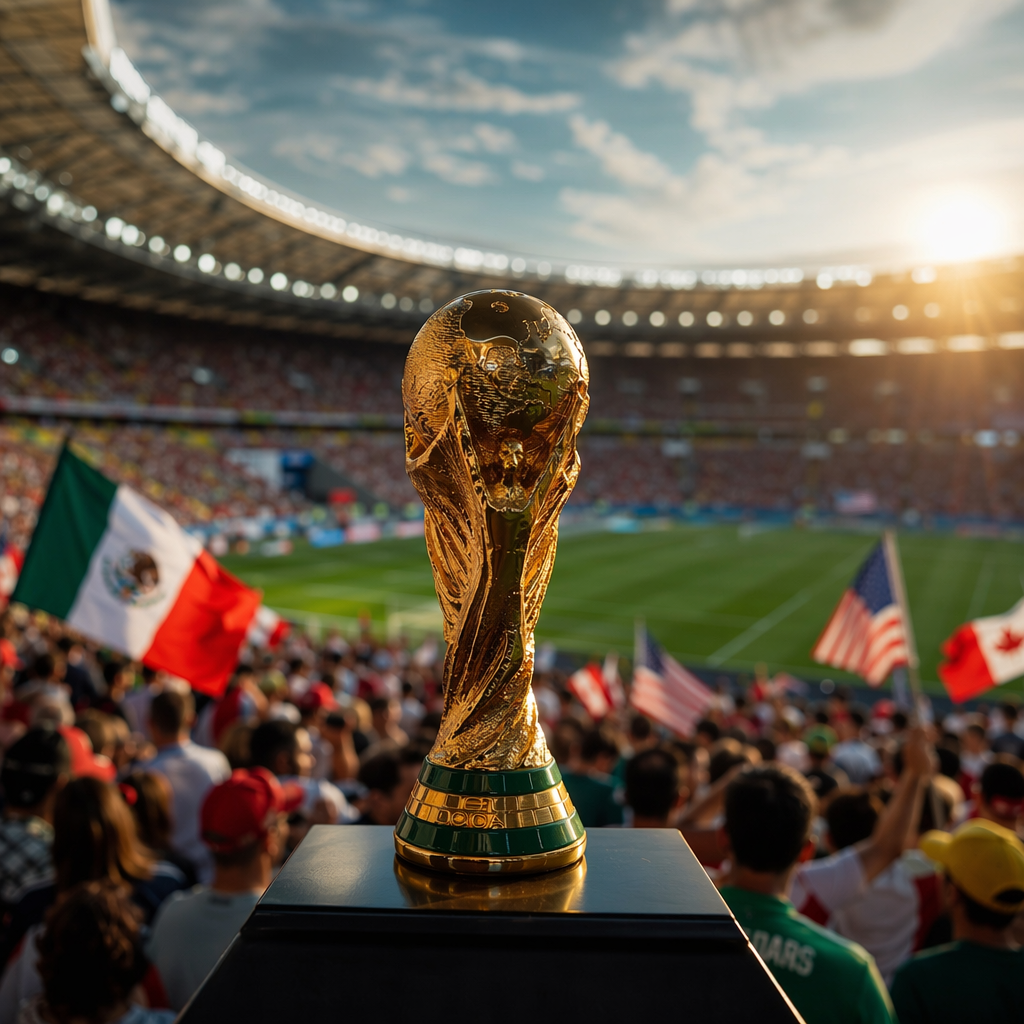
The FIFA World Cup 2026 will be the first edition to feature 48 national teams, 104 matches and three host countries. FIFA confirmed the expanded format in March 2023, and the tournament is scheduled to run from June 11 to July 19, 2026. As of 2026, the event is planned across the United States, Canada and Mexico, making it the first World Cup jointly hosted by three countries.
The opening match is scheduled for June 11, 2026, at Estadio Azteca in Mexico City, according to FIFA’s match schedule. The final is scheduled for July 19, 2026, at MetLife Stadium in East Rutherford, New Jersey. The venue, marketed by FIFA as New York New Jersey Stadium during the tournament, is one of 16 selected host city venues.
The 2026 tournament marks a major structural change from the 2022 FIFA World Cup in Qatar, which featured 32 teams and 64 matches. FIFA’s current format keeps four-team groups, with 12 groups of four teams. The top two teams from each group and the eight best third-placed teams will advance to a new round of 32.
Host countries and 16 selected cities
FIFA selected 16 host cities for the 2026 World Cup: 11 in the United States, three in Mexico and two in Canada. The selection was announced by FIFA in June 2022. As of 2026, these cities are scheduled to stage all 104 matches.
The United States will host matches in Atlanta, Boston, Dallas, Houston, Kansas City, Los Angeles, Miami, New York/New Jersey, Philadelphia, San Francisco Bay Area and Seattle. Mexico will host matches in Guadalajara, Mexico City and Monterrey. Canada will host matches in Toronto and Vancouver.
Three of the stadiums are especially significant historically. Estadio Azteca in Mexico City is scheduled to become the first stadium to host matches in three men’s World Cups, after staging games in 1970 and 1986. Mexico will also become the first country to host or co-host the men’s World Cup for a third time. The United States previously hosted the tournament in 1994, while Canada has not previously hosted the men’s World Cup, though it hosted the FIFA Women’s World Cup in 2015.
According to FIFA’s published schedule, the United States will stage the majority of matches, including the final. Canada will stage matches in Toronto and Vancouver, while Mexico will stage matches in Guadalajara, Monterrey and Mexico City.
Key tournament facts as of 2026
The 2026 FIFA World Cup includes several measurable changes compared with previous editions. The expansion affects qualification, match scheduling, travel planning and the number of teams from each confederation.
- 48 teams are scheduled to compete, compared with 32 teams in the 2022 tournament.
- 104 matches are scheduled, compared with 64 matches at the 2022 World Cup.
- 16 host cities across three countries will stage matches.
- 39 days are scheduled between the opening match on June 11 and the final on July 19, 2026.
- 12 groups of four teams will form the group stage.
- 32 teams will enter the knockout rounds, beginning with the round of 32.
Qualification and confederation slots
FIFA’s allocation for the 48-team tournament gives more places to each confederation than the 32-team format used through 2022. As of 2026, the allocation includes 16 places for UEFA, 9 direct places for CAF, 8 direct places for AFC, 6 direct places for CONMEBOL, 6 direct places for CONCACAF and 1 direct place for OFC. Two additional places will be decided through an intercontinental play-off tournament.
The three host nations — Canada, Mexico and the United States — qualify automatically. FIFA and CONCACAF confirmed that the automatic qualification places are counted within CONCACAF’s allocation for the tournament.
The expansion has clear numerical impact. Africa’s guaranteed representation rises from five places at the 2022 World Cup to nine direct places in 2026. Asia’s guaranteed representation rises from four direct places plus play-off access in 2022 to eight direct places. Oceania is guaranteed one direct place for the first time under the expanded format.
Reuters reported in March 2023 that FIFA had approved the 104-match format after reviewing the structure of the 48-team tournament. FIFA had previously considered 16 groups of three, but the approved format uses 12 groups of four, preserving each team’s minimum of three group-stage matches.
Match schedule and major venues
The FIFA match schedule places the first game in Mexico City and the final in New Jersey. The schedule also assigns major knockout matches across the three host countries.
Estadio Azteca will host the opening match on June 11, 2026. The venue has a long World Cup history, including the 1970 final won by Brazil and the 1986 final won by Argentina. FIFA’s schedule lists Mexico City as the site of the first match of the 2026 tournament.
MetLife Stadium, in East Rutherford, New Jersey, will host the final on July 19, 2026. FIFA announced the final venue in February 2024 as part of the full match schedule. The stadium is used by the NFL’s New York Giants and New York Jets and is identified by FIFA during the tournament as New York New Jersey Stadium.
Other stadiums are scheduled to host quarter-finals, semi-finals or key knockout matches. FIFA’s 2024 schedule listed Atlanta and Dallas as semi-final venues, while Miami will host the third-place match. Quarter-finals are scheduled for Boston, Los Angeles, Miami and Kansas City.
Dallas is scheduled to stage nine matches, the most assigned to any host city in FIFA’s schedule. New York/New Jersey is scheduled to stage eight matches, including the final. As of 2026, the distribution reflects FIFA’s decision to spread matches across time zones and regions in North America.
Security, border planning and government coordination
The World Cup requires coordination among federal, state, provincial and municipal authorities in three countries. Publicly available government releases from the United States, Canada and Mexico show planning across transport, border processing, policing, emergency services and tourism.
In the United States, matches will be held across 11 metropolitan areas. The U.S. Department of State and Department of Homeland Security have roles in visa processing, border entry and security coordination for international visitors. The tournament is also expected to coincide with other major events in the United States during the same period, including the country’s 250th anniversary events in 2026, which government agencies have publicly referenced in planning materials.
Canada’s federal and local authorities have announced preparations connected with Toronto and Vancouver host city responsibilities. Vancouver’s municipal government has published planning updates covering fan festivals, transport, public safety and budget oversight. Toronto has also released public documents on event delivery and costs, including city-level responsibilities related to hosting matches.
Mexico’s government and local authorities are responsible for host city preparation in Mexico City, Guadalajara and Monterrey. Their roles include stadium-area mobility, policing and coordination around international travel. Mexico City’s Estadio Azteca is scheduled for renovation work linked to the tournament.
Economic and tourism data
The 2026 World Cup will take place in three of the world’s largest tourism markets. According to UN Tourism data released in 2024, international tourism continued recovering after the COVID-19 period, and the United States, Mexico and Canada remained major destinations for international travel.
Government and local host city documents provide some measurable planning figures. Toronto city documents have estimated municipal hosting costs in the hundreds of millions of Canadian dollars, including security, transportation, fan programming and operations. Vancouver city documents have similarly published budget estimates for local delivery, including public safety and event operations.
In the United States, several host cities have cited anticipated visitor numbers and public safety planning in local government releases. These figures vary by city and depend on match assignments, fan festivals and length of stay. Because final attendance and visitor totals cannot be confirmed before the tournament, official data will be available only after the event.
For direct stadium attendance, the 2026 World Cup has the potential to exceed previous tournaments because it includes 104 matches and many large-capacity stadiums. The 1994 World Cup in the United States recorded total attendance of more than 3.5 million, according to FIFA’s historical statistics, despite having only 52 matches. The 2026 edition has twice as many matches as 1994.
Broadcasting and commercial rights
FIFA sells media and commercial rights separately by territory. In the United States, Fox Sports holds English-language rights for the 2026 World Cup, while Telemundo holds Spanish-language rights. These rights are part of FIFA’s commercial agreements covering tournaments in the 2023–2026 cycle.
In Canada, coverage rights have been held by Bell Media properties including TSN, RDS and CTV under FIFA agreements. In Mexico, World Cup matches have historically been shown through major broadcasters including TelevisaUnivision and TV Azteca under FIFA rights arrangements.
FIFA’s financial reports for the 2019–2022 cycle showed record revenue of $7.6 billion, helped by the 2022 World Cup in Qatar. FIFA has projected higher revenue for the 2023–2026 cycle, supported by the expanded World Cup format, additional matches and commercial activity. These projections are reported in FIFA financial documents and are subject to final reporting after the cycle closes.
Teams, draw and competitive structure
The final draw for the 2026 FIFA World Cup will determine the 12 groups. FIFA has not completed all qualification places until the qualifying competitions and intercontinental play-offs conclude. As of 2026, the tournament structure is fixed, but the final list of teams depends on qualification results.
Each team will play three group-stage matches. The top two teams in each group will advance automatically, along with the eight best third-placed teams. The knockout phase will then proceed through the round of 32, round of 16, quarter-finals, semi-finals, third-place match and final.
This format differs from the 2022 World Cup, where 16 teams advanced from eight groups of four. The 2026 structure increases the number of knockout-stage teams from 16 to 32 and adds one additional knockout round for teams that reach the final.
The total maximum number of matches for a finalist will be eight. In the 2022 format, a finalist played seven matches. This is one of the practical effects of the expanded knockout stage.
Why the 2026 edition is structurally different
The 2026 FIFA World Cup is not only larger by team count. It is also different in geography, qualification access and match volume. Three countries will share hosting duties across a wide travel area covering multiple time zones. The schedule includes venues from Vancouver and Seattle in the Pacific Northwest to Miami and New York/New Jersey on the eastern side of North America.
The expansion to 48 teams also changes the qualification landscape. More national teams from Africa, Asia, North America, South America, Europe and Oceania can qualify directly compared with the previous format. FIFA has described the expansion as part of its plan to increase global participation in the men’s World Cup.
For host cities, the tournament is a major logistical event. Stadium operations, public safety, transport, accommodation and fan zones are being planned by local organizing committees with government agencies. Published host city documents show that preparation includes budgets, procurement, security planning, traffic management and public communications.
What is confirmed before the tournament
Several details are already confirmed through FIFA and government sources. The event will be hosted by Canada, Mexico and the United States. It will feature 48 teams and 104 matches. The opening match will be in Mexico City on June 11, 2026, and the final will be in New York/New Jersey on July 19, 2026.
The tournament will use 12 groups of four teams. Thirty-two teams will advance to the knockout rounds. Sixteen host cities will stage matches. Dallas is scheduled to host the most matches, while MetLife Stadium is scheduled to host the final.
Other details, including the full list of qualified teams, final squad selections, ticket demand, confirmed attendance and economic impact after the event, can only be verified once qualification, ticketing and the tournament itself are completed.
Sources: Reuters, Government releases, publicly available data.
Comments
Post a Comment