Suryakumar Yadav and the modern T20 template
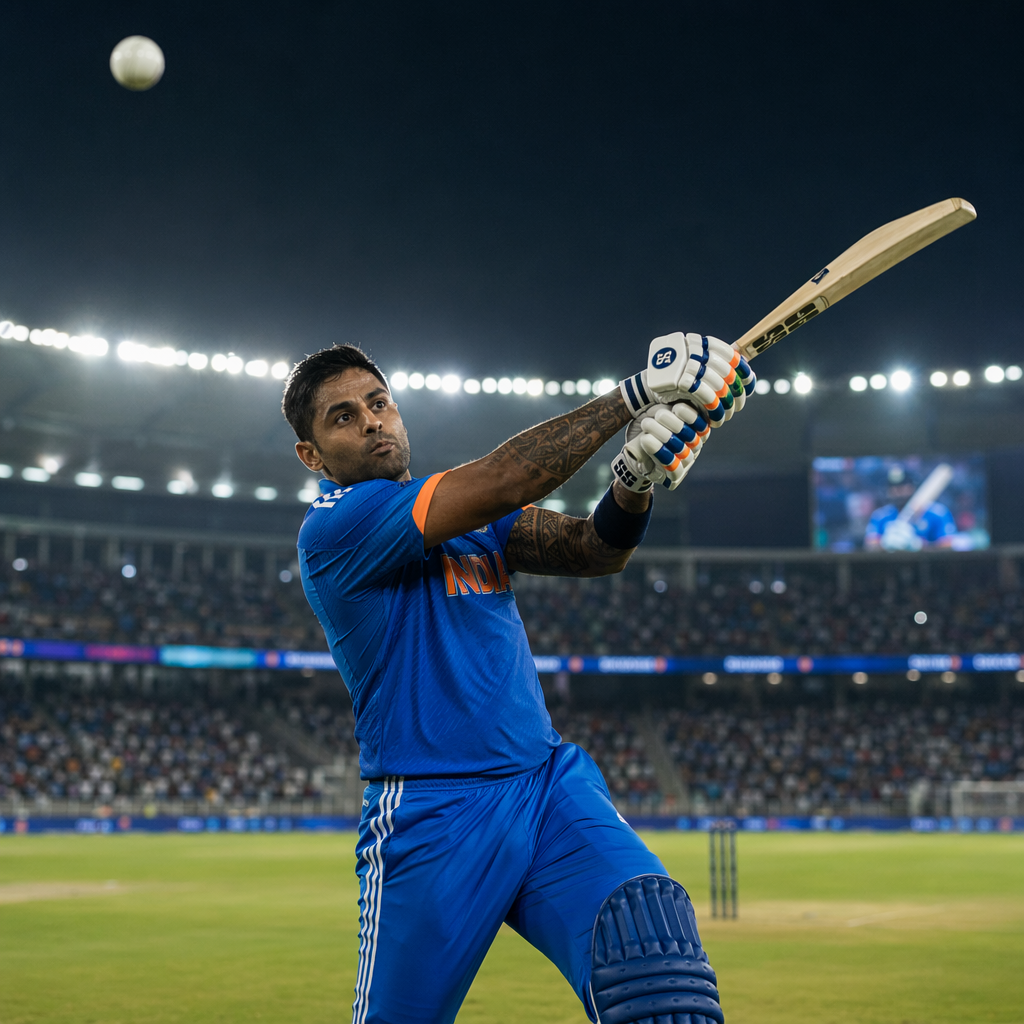
Suryakumar Yadav has become one of the clearest symbols of how Twenty20 cricket has changed: high-risk scoring is no longer treated as an emergency option, but as a full-time batting method. In India’s white-ball setup, his name is now closely associated with range-hitting, boundary access behind square, and a style of batting that forces captains to defend parts of the field once considered low-risk.
The interest around Suryakumar is not only about spectacular shots. It is also about timing. Between 2024 and 2026, Indian cricket has been navigating leadership transitions, player workloads, franchise commitments, and the continuing growth of T20 as the sport’s most commercially visible format. In that environment, a batter who can shift a match in a few overs has obvious value.
This article looks at Suryakumar Yadav’s profile, his rise, his role in India’s T20 structure, and why his career is frequently discussed when the future of short-format batting is debated. It also notes that the trend-feed source supplied for this article points to a Google Trends RSS link titled “भारतीय रिज़र्व बैंक,” which is not a cricket-specific primary source. For that reason, the article avoids adding unverified scorecards, rankings, or statistics that cannot be attributed from the provided reference.
From domestic cricket to India recognition
Suryakumar Yadav’s journey is often cited because it did not follow the fastest possible route from domestic promise to international security. Born in Mumbai and shaped by the city’s demanding club and domestic cricket culture, he built his reputation through the Ranji Trophy system and the Indian Premier League. Mumbai cricket has historically valued adaptability, and Suryakumar’s development reflected that environment: he learned to handle the moving red ball, rotate strike on slower surfaces, and later expand his stroke range for franchise cricket.
His IPL career gave him a larger stage. Before he became a regular figure for India in T20 internationals, he was known among league followers as a batter who could bat in different positions and maintain scoring tempo. That flexibility mattered. Franchise teams increasingly prefer players who do not require one fixed role, and Suryakumar fitted that requirement by being able to bat in the middle order while still creating powerplay-like momentum.
His international rise came later than some contemporaries, but that delay also meant he arrived with a clearer game. By the time he became a central part of India’s T20 plans, he was not a raw prospect being tested; he was an experienced domestic and IPL performer whose attacking method had already survived high-pressure league cricket.
The “360-degree” label and what it means
The phrase “360-degree batter” is often used loosely, but in Suryakumar Yadav’s case it describes a specific feature: he scores in areas where most batters mainly look to deflect rather than attack. He can use pace behind the wicketkeeper, lift fast bowlers over fine leg, manufacture access over point, and still hit conventional boundaries down the ground. That range makes standard field settings less secure.
For bowlers, the challenge is not merely that he can hit big shots. It is that he can turn otherwise disciplined deliveries into scoring opportunities. A back-of-a-length ball outside off stump may be guided or lifted behind square. A slower ball into the pitch can be waited on. A yorker that misses by a small margin can be opened up with the wrists. These options create tactical pressure before the ball is delivered.
However, the same method carries risk. High-tempo batting can produce dismissals that appear unusual or avoidable. Suryakumar’s career has therefore also generated debate about risk management, especially in formats where recovery time is limited. In T20 cricket, the calculation is different from Tests or even one-day cricket: a 15-ball innings that changes the required rate can be as strategically important as a longer stay at the crease.
Why his T20 role is distinct
India’s T20 sides have often included top-order anchors, finishers, and all-rounders. Suryakumar occupies a role that sits between those categories. He is usually not a traditional opener, and he is not limited to the final overs. His most valuable phase can be the middle overs, where spin and pace changes are used to slow scoring after the field spreads.
In that phase, his ability to score boundaries without needing several deliveries to settle can alter the innings curve. Teams defending in the middle overs often depend on dot balls. Suryakumar’s method reduces that comfort because he is willing to attack both seamers and spinners early in his innings.
The central tactical value is that he can stop an innings from drifting. If India lose early wickets, he can counterpunch. If India start well, he can accelerate the advantage. If the pitch is slow, he can use angles instead of relying only on brute force. That variety explains why analysts and commentators repeatedly discuss him in the context of modern T20 batting.
Leadership and responsibility
Suryakumar Yadav’s career has also moved beyond batting. In recent seasons, he has been discussed in connection with leadership responsibilities in India’s T20 environment. Leadership in this format is not only about bowling changes or field placements. It also requires reading match-ups, protecting players from overextension, and judging when aggression is worth the risk.
For a captain or senior batter in T20 cricket, communication can be as important as technical expertise. Batters must know whether to attack a match-up, consolidate briefly, or target a specific bowler. Suryakumar’s own batting approach gives him insight into that balance, but it also places expectations on him: he is often judged not only by his runs but by whether his decision-making matches the game situation.
This is where his career becomes especially relevant for India’s next T20 cycle. With multi-format workloads affecting many leading cricketers, T20 teams need specialists and senior figures who understand the rhythm of short-format cricket. Suryakumar fits that description, although selection and leadership decisions remain matters for official cricket bodies and team management.
Four dated context points from 2024-2026
The available trend-feed reference does not provide cricket match data, so the following points are framed as dated context rather than unsourced performance statistics:
- 2024: India’s cricket calendar included the ICC Men’s T20 World Cup cycle, a period in which T20 specialists such as Suryakumar Yadav attracted heightened public and media attention.
- 2024: Indian cricket’s post-tournament T20 planning placed greater focus on role clarity, including middle-order acceleration and leadership depth.
- 2025: Franchise cricket remained a central platform for Indian T20 players, with the IPL continuing to influence selection discussions and short-format form assessments.
- 2026: The next major T20 cycle was expected to keep attention on players capable of combining experience, strike rotation, and boundary scoring in pressure phases.
These points should not be read as match statistics. They are calendar-based context tied to the 2024-2026 period and the broader environment in which Suryakumar Yadav’s role is discussed.
The IPL factor
The Indian Premier League has been crucial to Suryakumar Yadav’s public profile. It exposed him to high-quality bowling attacks, large crowds, and tactical analysis from coaches and opponents. For a batter whose game depends on quick decision-making, that environment is valuable.
In the IPL, a middle-order batter may enter after a strong start, a collapse, or a tactical reshuffle. This is different from opening, where conditions are clearer at the beginning of an innings. Suryakumar’s success has depended on reading the match immediately: the pitch pace, the boundary size, the bowler’s plan, and the field. That skill translated naturally to international T20 cricket, where time to settle is limited.
Franchise cricket also sharpened his reputation as a player comfortable against both pace and spin. In Indian conditions, spin-hitting is essential, but in global tournaments, pace manipulation can be just as important. Suryakumar’s scoring areas behind square give him a route against fast bowlers even when the straight boundary is protected.
Technique behind the innovation
Unusual shots can look improvised, but they are usually built on repeatable mechanics. Suryakumar’s batting depends on a stable base, quick hands, and late adjustment. He often uses the bowler’s pace rather than trying to overpower every ball. This is especially visible in shots over fine leg or behind point, where timing and angle matter more than strength.
His head position is also important. When he plays across or behind the wicket, he generally keeps enough balance to control the direction of the shot. That does not remove risk, but it makes the stroke more than a guess. In T20 cricket, where bowlers constantly vary pace and length, late hands and balance allow a batter to keep multiple options open.
Another part of his technique is premeditation used selectively. Many T20 batters pre-plan shots, but the best ones retain an escape route if the ball is not where expected. Suryakumar’s range allows him to convert one plan into another. A planned ramp can become a glide. A leg-side movement can open space through cover. This flexibility is central to his effectiveness.
Public image and pressure
With visibility comes scrutiny. Suryakumar Yadav’s attacking style can create sharp swings in public reaction. A successful innings is praised as fearless and modern; an early dismissal can be criticised as reckless. This is a familiar tension for T20 specialists. Their job often involves taking risks that will sometimes fail.
The challenge is magnified in India, where cricket coverage is intense and every major innings is discussed across television, digital media, and social platforms. For a player like Suryakumar, maintaining clarity is therefore essential. The method cannot change every time criticism rises, but it must remain adaptable enough to suit conditions and team needs.
His reputation has largely been built on accepting that trade-off. He is not viewed as a conventional accumulator. He is selected and followed because he can bend the scoring pattern of a T20 innings. That role naturally brings volatility.
What his career says about modern batting
Suryakumar Yadav’s importance goes beyond one player’s record. He represents a broader shift in batting education. Younger players now train for boundary options in every direction. They practise ramps, scoops, reverse hits, and open-faced shots not as novelty strokes but as regular tools. The game has changed because fielding restrictions, data analysis, and match-up planning have made predictable scoring methods easier to defend.
A batter who can score only in two or three zones is easier to contain. A batter who can threaten six or seven zones changes the defensive map. Suryakumar’s rise shows why modern teams value range as much as traditional correctness. Technique still matters, but technique is now judged by effectiveness across formats and phases.
At the same time, his example should not be reduced to flair. The foundation of his game was built through domestic cricket, long practice, and repeated exposure to competitive pressure. The spectacular shots are the visible result; the less visible work is the reading of length, field, and bowler intention.
The road ahead
As Indian cricket continues through the 2024-2026 period, Suryakumar Yadav’s relevance will depend on fitness, form, and the role assigned to him by selectors and team management. T20 cricket moves quickly. Younger players emerge through the IPL every season, and established names must keep adapting.
For Suryakumar, the key question is not whether he can play extraordinary shots; that has already been established. The more important question is how consistently he can align aggression with match situation, especially when carrying senior responsibility. If he does, he remains one of the most influential T20 batters in India’s setup.
His career is a case study in modern short-format cricket: delayed international entry, franchise validation, technical innovation, and the constant tension between risk and reward. Whether viewed as a batter, a senior figure, or a symbol of India’s T20 evolution, Suryakumar Yadav remains one of the most discussed cricketers of his generation.
Comments
Post a Comment