Realme: From Online Challenger to Everyday Smartphone Brand
Realme’s rise is one of the clearest examples of how India’s smartphone market changed in the last few years: a brand that began with online-first launches and aggressive pricing is now competing across budget, mid-range, 5G, audio, wearables and smart-home categories. For many Indian buyers, Realme is no longer just an alternative to bigger smartphone names; it is a familiar option in retail stores, e-commerce sales and telecom-linked 5G upgrades.
The renewed interest around “रियलमी” also reflects a broader pattern. Indian consumers are upgrading devices more carefully, comparing processors, camera sensors, charging speeds, software policies and after-sales service before buying. Realme has positioned itself in the middle of this decision-making process: affordable enough for value seekers, but increasingly focused on features that were once limited to premium phones.
Realme was founded in 2018 and operates as a consumer technology brand best known for smartphones. In India, it has marketed phones across several series, including number-series models, Narzo devices, C-series budget phones and GT-series performance phones. The company has also expanded into earbuds, smartwatches, chargers and connected accessories. While the exact availability of products varies by date and channel, the brand’s larger strategy has been consistent: launch frequently, target younger consumers, and compete on specifications.
Why Realme Matters in India’s Smartphone Market
India is one of the world’s largest smartphone markets by users and shipments, and that scale gives brands like Realme a major opportunity. The country’s smartphone buyers are highly price-sensitive, but they are also demanding. In the same price bracket, shoppers often compare display refresh rate, camera megapixels, battery size, fast-charging wattage, chipset generation and 5G band support.
Realme built early momentum by offering combinations of these features at competitive prices. Its product language often highlights large batteries, fast charging, high-refresh displays and performance-focused chipsets. The brand has also tried to create clear identities across product lines. The C series is generally associated with entry-level affordability, the Narzo line with youth and performance marketing, the number series with mainstream all-rounders, and the GT line with higher performance.
That segmentation matters because India’s smartphone market is not one market. It includes first-time smartphone buyers, students, gamers, content creators, small-business owners, and users upgrading from older 4G devices to 5G phones. Realme’s strength has been its ability to serve many of these groups without relying only on flagship pricing.
Important 2024–2026 Context
Several dated facts help explain the environment in which Realme is operating. First, the Government of India’s Department of Telecommunications and telecom operators continued the expansion of 5G services after the commercial launch period, shaping consumer demand for affordable 5G smartphones in 2024. This supported the broader push by brands, including Realme, to bring 5G capability into lower price bands.
Second, the Telecom Regulatory Authority of India has continued publishing subscriber and broadband data through 2024, showing that mobile internet remains central to India’s digital economy. While these figures are not specific to Realme, they are directly relevant to the market Realme sells into: phones are the main device through which millions of users access payments, streaming, education, messaging and government services.
Third, Counterpoint Research and IDC have reported through 2024 that India’s smartphone market became more competitive in the 5G and premiumisation segments, with brands trying to grow average selling prices while also protecting the mass market. Realme’s portfolio reflects that pressure: budget phones remain important, but the brand has also continued to promote faster charging, better displays and more capable chipsets in mid-range products.
Fourth, in 2024, Android smartphone brands faced increasing attention around software updates and device longevity. Google’s longer update commitments on Pixel devices and Samsung’s extended software policies increased consumer awareness. Realme, like other Android brands, has had to communicate more clearly about update schedules and security patches, especially for buyers planning to keep phones for three to five years.
Fifth, India’s Bureau of Indian Standards and other regulatory systems continue to shape electronics compliance, including safety and quality standards for devices and accessories. For smartphone brands, compliance is a basic but essential part of operating in the country’s retail and e-commerce ecosystem.
Product Strategy: Speed, Screens and Battery Life
Realme’s product identity is closely tied to specifications. The brand often promotes fast charging as a headline feature. In practical terms, this matters for Indian users who rely on one device throughout the day for commuting, work, payments, video calls and entertainment. A phone that can charge quickly during a short break can feel more useful than one with a slightly better benchmark score.
Displays are another focus. High-refresh-rate screens, once limited to more expensive devices, are now common in lower and mid-range smartphones. Realme has been part of that shift, bringing smoother displays to a wider set of buyers. This helps with gaming, scrolling, and general responsiveness, though actual experience still depends on chipset performance and software optimisation.
Battery capacity remains central. Many Realme phones have used large batteries, typically marketed around all-day use. For Indian consumers in areas with long travel times, inconsistent charging access, or heavy video consumption, battery life is one of the most practical buying factors.
Camera marketing is also important, but this is where buyers should be careful. Smartphone camera quality depends on more than megapixel counts. Sensor size, lens quality, image processing, optical or electronic stabilisation, and low-light performance all affect real results. Realme has offered high-resolution sensors in many models, but users should compare independent reviews before choosing a phone mainly for photography.
Realme and the 5G Upgrade Cycle
The 5G transition is one of the most important forces behind recent smartphone upgrades in India. As telecom operators expanded networks, smartphone brands pushed 5G support into more affordable models. Realme has participated strongly in this cycle by offering multiple 5G models across price segments.
For consumers, however, “5G phone” should not be the only purchase criterion. Buyers should check whether the device supports the 5G bands used by Indian telecom operators, whether software updates are reliable, and whether the chipset can handle long-term performance. A cheaper 5G phone may look attractive, but if storage is limited or software support is weak, the ownership experience may decline after a year or two.
Realme’s challenge is to balance affordability with durability. The Indian market rewards low prices, but it also punishes poor after-sales support and weak long-term performance. As phones become more central to financial transactions and digital identity, reliability matters as much as launch-day specifications.
What Buyers Should Check Before Choosing a Realme Phone
Realme’s wide catalogue can be useful, but it can also confuse buyers. Similar-looking models may differ in chipset, storage type, camera setup, display brightness and charging speed. Before purchasing, buyers should compare the exact model name and configuration rather than relying only on series branding.
- Processor and storage: Check the chipset generation, RAM, and whether the phone uses faster storage technology.
- Software policy: Look for the promised Android version upgrades and security patch period for the specific model.
- 5G bands: Confirm support for Indian network bands, especially if buying from non-official channels.
- Charging and charger availability: Verify whether the fast charger is included in the box and whether it uses proprietary charging technology.
- Service network: Check nearby authorised service centres before buying a higher-priced device.
- Camera reviews: Compare real photo and video samples instead of relying only on megapixel claims.
Competition: Xiaomi, Samsung, Vivo, iQOO and Others
Realme’s growth cannot be understood without looking at its competitors. Xiaomi has long been strong in value-focused online sales. Samsung has a broad offline network and strong brand trust. Vivo and Oppo compete heavily in design, cameras and retail presence. iQOO targets performance-focused buyers, while Motorola and OnePlus compete in selected price bands.
In this environment, Realme must keep prices attractive without weakening margins. The company also has to maintain enough product distinction so that buyers understand why one Realme model is different from another. This is not easy in India, where multiple brands may launch phones with similar displays, batteries and processors within weeks of each other.
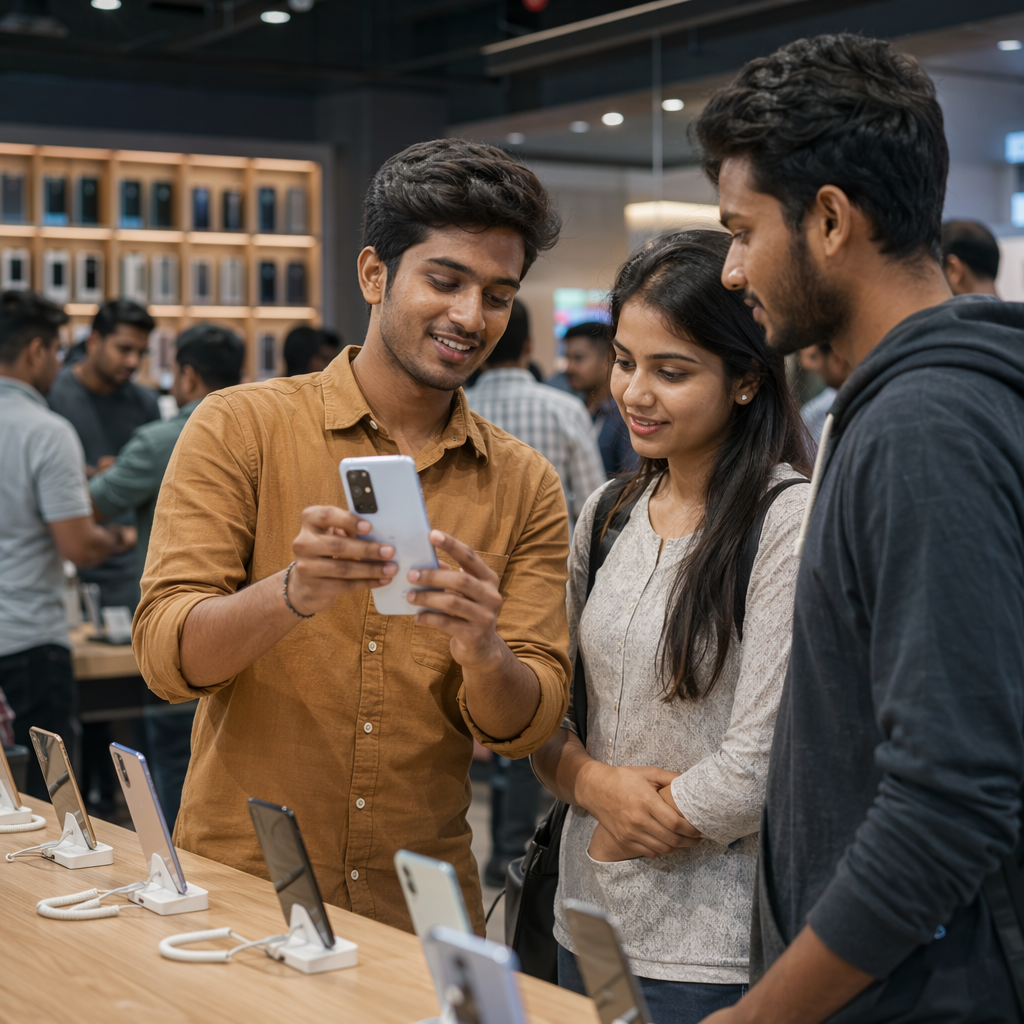
Offline retail also matters. Early online popularity helped Realme reach young buyers, but a large part of India still buys phones after seeing them physically in stores. Retail margins, local promotions, financing offers and exchange deals can influence decisions as much as online specifications.
Software and User Experience
Realme phones run Realme UI, based on Android. The interface includes customisation features, battery tools, gaming modes and pre-installed applications. For some users, this adds convenience. For others, bloatware and notifications can be a concern. The best approach is to check recent reviews of the exact model because software behaviour can vary between price segments and update versions.
Software has become a major differentiator in smartphones. A phone with strong hardware can feel frustrating if updates are delayed or if background apps affect performance. At the same time, a well-optimised mid-range phone can offer a better daily experience than a more expensive device with poor thermal management or cluttered software.
For Realme, software consistency will be increasingly important. As the hardware gap narrows across brands, buyers may place more value on clean interfaces, update reliability, privacy controls and long-term security.
After-Sales Service and Consumer Trust
After-sales service is a decisive factor in India. Smartphone repairs can be expensive, and users depend on their phones for work, travel, banking and education. A cracked display, battery issue or charging-port problem can disrupt daily life. Realme lists service support through its official channels, but buyers should verify local availability before purchasing.
Consumer trust is built not only at launch but over the full ownership cycle. Timely repairs, transparent spare-part pricing, clear warranty terms and reliable software updates all affect whether users return to the same brand. In a market where customers often upgrade every few years, repeat buyers are valuable.
Realme Beyond Smartphones
Realme has also entered connected devices, especially wireless earbuds and accessories. This reflects a larger strategy seen across the smartphone industry: once a consumer buys a phone, the brand tries to sell compatible audio products, chargers, smartwatches and lifestyle devices. The ecosystem approach can increase convenience, but it can also make buyers dependent on brand-specific features.
In India, true wireless earbuds have become popular because of streaming, calls, online classes and gaming. Realme’s audio products compete in affordable segments where battery life, microphone quality and durability are key. However, buyers should check water-resistance ratings, codec support and warranty terms before buying.
The Road Ahead
Between 2024 and 2026, Realme’s future in India depends on three major questions. Can it keep affordable 5G phones competitive as component costs change? Can it improve software support and user trust as consumers keep phones longer? And can it stand out in a crowded market where rivals quickly match specifications?
The brand has clear advantages: strong recognition among young consumers, a broad product portfolio and a history of aggressive pricing. But the smartphone market is becoming more mature. Buyers are no longer impressed only by large numbers on spec sheets. They want phones that remain fast, secure and useful after two or three years.
For Indian consumers searching for “रियलमी,” the practical takeaway is simple. Realme can offer strong value, especially in budget and mid-range categories, but the right choice depends on the exact model, update commitment, service access and real-world performance. In a market full of similar-looking phones, careful comparison is still the best tool a buyer has.
Comments
Post a Comment