Bengaluru in 2026: India’s Tech Capital Balances Growth, Congestion and Climate Stress
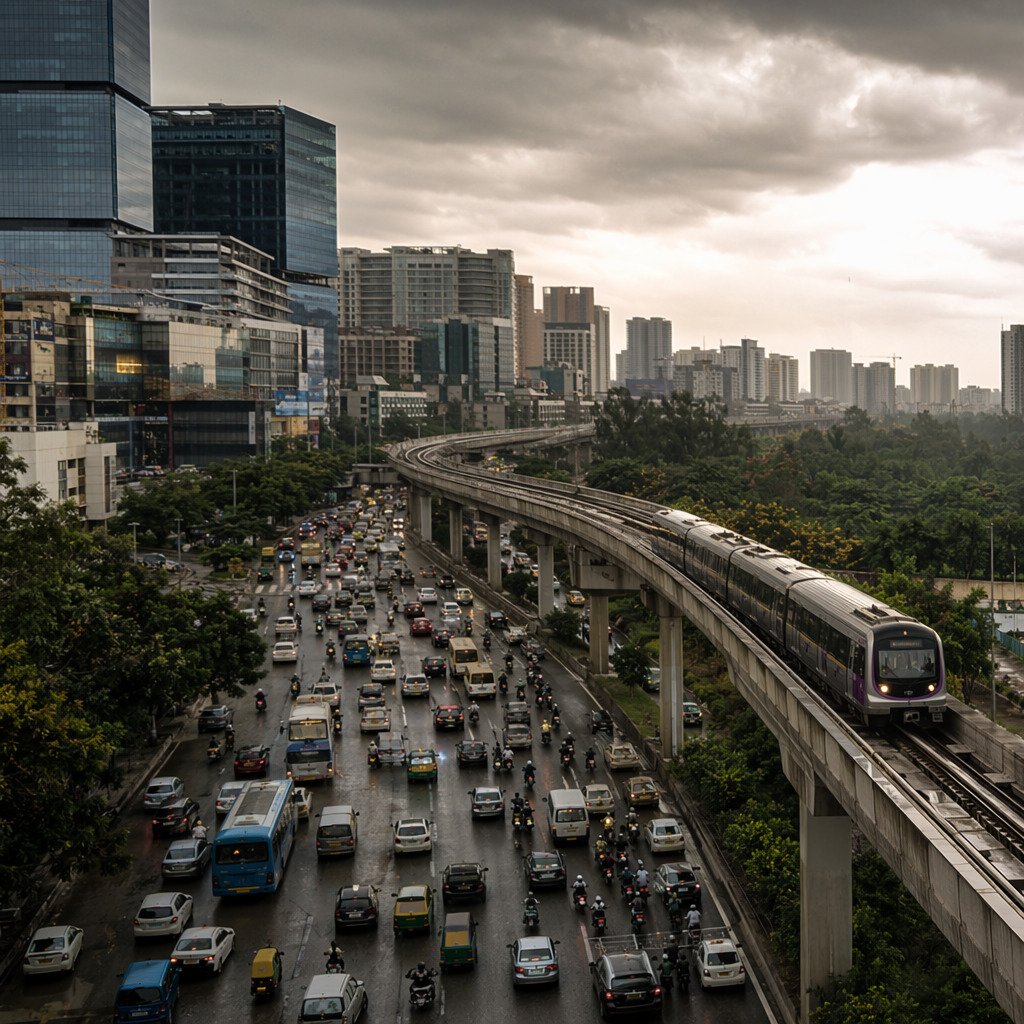
Bengaluru remains one of India’s most influential urban economies, but the city’s recent story is no longer only about technology parks, start-ups and real estate. In 2024 and 2025, the Karnataka capital was also discussed nationally for water stress, transport pressure, flooding risks, civic governance and the continuing expansion of its metropolitan footprint.
The city’s appeal is clear. Bengaluru is the administrative capital of Karnataka, a major centre for information technology and biotechnology, and the base for several Indian and multinational companies. It is also home to public institutions, research centres, defence and aerospace facilities, universities, hospitals and a large service economy that supports millions of residents.
But the same growth has made urban management more complex. Roads that connect employment hubs, residential neighbourhoods and surrounding towns face heavy congestion. Water supply depends on a combination of the Cauvery river, groundwater and local storage systems. Lakes, stormwater drains and low-lying areas remain central to debates about flooding. For residents, employers and public agencies, Bengaluru’s next phase depends on whether infrastructure can keep pace with expansion.
A city shaped by technology, migration and public institutions
Bengaluru’s modern identity is closely tied to technology-led growth. The city’s IT corridors, including areas around Outer Ring Road, Whitefield, Electronic City and North Bengaluru, have drawn workers from across India. That migration has added to the city’s cultural diversity and consumer economy, supporting restaurants, rental housing, transport services, retail businesses and co-working spaces.
At the same time, Bengaluru is not only a private-sector technology hub. Public-sector and research institutions have long shaped the city’s economy and reputation. Organisations connected to aerospace, defence, science, management education and medical research have helped create a skilled labour base. This mix of public institutions and private companies is one reason the city continues to attract investment even when national and global technology hiring cycles change.
State and city agencies have also promoted Bengaluru as a start-up and innovation centre. Karnataka government initiatives have frequently described the city as central to the state’s technology economy, while national agencies and industry bodies have identified it as a major hub for venture-backed firms. These claims should be read alongside the everyday pressures that fast-growing cities face: rising rents in some areas, uneven civic infrastructure and long commutes.
Transport: metro expansion and the pressure on roads
For many residents, transport is the clearest measure of Bengaluru’s growth. The city’s road network carries private vehicles, buses, taxis, auto-rickshaws, delivery fleets and intercity traffic. Major corridors can become slow during peak office hours, especially around technology clusters and arterial junctions.
The Bengaluru Metro, operated by Bangalore Metro Rail Corporation Limited, has become a critical part of the city’s mobility plan. Its network expansion has been closely watched because metro connectivity can reduce travel time for some commuters and encourage transit-oriented development around stations. However, construction phases can also disrupt local traffic, utilities and businesses.
Bengaluru’s transport challenge is not limited to metro rail. Bengaluru Metropolitan Transport Corporation buses remain essential for daily travel, particularly for people who do not use private vehicles. App-based cabs, autos and two-wheelers fill gaps in last-mile travel but also add to road volumes. Public agencies have discussed measures such as bus priority, traffic signal improvements, parking regulation and suburban rail integration, but implementation across a wide metropolitan region is difficult.
The key transport issue is integration. Metro stations, bus stops, footpaths, cycle access, parking controls and rail terminals need to work together for public transport to become a practical alternative to private vehicles. Without reliable last-mile connections, even expanded rail networks may not fully reduce road congestion.
Water stress and the 2024 warning
Bengaluru’s water situation drew national attention in 2024 after parts of the city faced shortages during a dry period. Karnataka authorities and civic bodies discussed restrictions, supply management and enforcement against wasteful use. The issue highlighted a long-running concern: Bengaluru’s rapid urbanisation has reduced the role of local lakes and groundwater recharge even as demand has continued to rise.
The Bangalore Water Supply and Sewerage Board supplies Cauvery water to large parts of the city, while many households, apartments and commercial buildings also depend on borewells and private tankers. This mixed system is vulnerable when rainfall is weak, groundwater levels fall or infrastructure cannot meet local demand.
Water experts and government agencies have repeatedly pointed to the importance of lake restoration, wastewater reuse, rainwater harvesting and leakage reduction. These are not quick fixes. They require enforcement, maintenance and coordination between state departments, the city corporation, water utilities, residents’ associations and private developers.
The 2024 experience made water security a mainstream urban issue rather than a technical discussion. It also showed why Bengaluru’s growth model increasingly depends on resource planning, not only on new roads, offices and housing projects.
Flooding, lakes and the built environment
Bengaluru’s relationship with water is complicated because the city can face shortage and flooding in different seasons. Intense rain can overwhelm stormwater drains, especially where natural drainage channels have been narrowed or blocked. Low-lying layouts and areas near lake systems are particularly vulnerable.
In recent years, flooding around parts of the IT corridor and residential neighbourhoods has led to public scrutiny of encroachments, drain maintenance and planning approvals. Courts, civic bodies and state agencies have all played roles in discussions about lake buffer zones, stormwater drain clearance and urban planning. The challenge is partly legal and partly administrative: identifying encroachments, acting on them consistently and maintaining drainage networks before the monsoon.
Lakes remain important for Bengaluru’s climate resilience. Beyond their ecological value, they can support groundwater recharge and reduce flooding when connected systems function properly. But restored lakes require continuing maintenance, sewage control and protection from dumping. A cleaned lake can deteriorate again if untreated sewage or construction waste enters the system.
Governance and the challenge of scale
Bengaluru’s governance structure is often described as fragmented. Several agencies influence roads, water, land use, transport, waste, electricity, policing and planning. The Bruhat Bengaluru Mahanagara Palike, Bangalore Development Authority, Bangalore Water Supply and Sewerage Board, Bangalore Metro Rail Corporation Limited, Bengaluru Metropolitan Transport Corporation and state departments all have overlapping roles in the wider urban region.
This structure can make accountability difficult for residents. A broken footpath, blocked drain, water supply issue or road excavation may involve more than one department. Coordination becomes especially important when infrastructure projects overlap, such as metro construction, road widening, utility shifting and flood-control works.
Governance questions have also included municipal representation and ward-level administration. Bengaluru’s civic management depends not only on large projects but also on local execution: garbage collection, pothole repair, drain cleaning, street lighting, public toilets and footpath maintenance. For a city known globally for software and innovation, basic service delivery remains a central test.
Housing, work patterns and neighbourhood change
Bengaluru’s residential geography has changed alongside its employment map. Areas once considered peripheral have become dense housing and office zones. Whitefield, Sarjapur Road, Bellandur, Thanisandra, Yelahanka and parts of North Bengaluru have seen rapid construction, while older neighbourhoods such as Jayanagar, Malleswaram, Basavanagudi, Indiranagar and Koramangala continue to balance residential life with commercial activity.
Hybrid work, which expanded during the COVID-19 period, has had mixed effects. Some workers spend fewer days commuting, while others have returned to office-heavy schedules. Employers’ policies vary across technology, consulting, finance, start-ups and support services. This has affected office demand, rental preferences and traffic patterns, although the overall direction remains tied to Bengaluru’s role as a major employment centre.
Housing affordability is uneven. Premium neighbourhoods and corridors near major offices can be expensive, while more distant localities may offer lower rents but longer commutes. New apartment clusters often depend on private water tankers, borewells, internal waste systems and private security, reflecting gaps in citywide infrastructure provision.
What residents and businesses are watching
Bengaluru’s near-term agenda is practical. The city’s future will be shaped less by slogans and more by whether agencies can deliver dependable services while managing growth. Residents and businesses are closely watching:
- Metro and suburban rail progress, especially whether new lines reduce travel time on congested corridors.
- Water supply planning, including Cauvery distribution, groundwater regulation, rainwater harvesting and wastewater reuse.
- Stormwater drain and lake management before and during monsoon seasons.
- Road quality and traffic enforcement, particularly around technology corridors and fast-growing suburbs.
- Waste management and local civic services, which affect public health and neighbourhood liveability.
- Land-use planning, including how new housing, offices and commercial spaces are matched with transport and utilities.
The economic importance of getting urban basics right
Bengaluru’s economic role gives its civic issues national significance. When roads flood near major employment hubs or when water shortages affect large residential clusters, the effects are not limited to local inconvenience. They can influence employee productivity, office operations, investment sentiment and the city’s ability to attract skilled workers.
Companies often choose Bengaluru because of its talent pool, supplier networks and business ecosystem. But employees also evaluate quality of life: commute times, air quality, housing costs, school access, healthcare, safety and recreational spaces. If urban services lag too far behind economic growth, the city risks making daily life harder for the same workforce that powers its economy.
This does not mean Bengaluru’s position is easily displaced. The city has deep advantages: established institutions, a large skilled workforce, a dense technology ecosystem and a strong brand among Indian and global employers. But maintaining that position requires sustained public investment and more predictable urban governance.
Climate resilience as a planning priority
Bengaluru’s climate concerns are increasingly visible through heat, water stress and heavy-rain events. Urban expansion can intensify these issues when open spaces shrink, tree cover declines and paved surfaces increase. Heat can be worse in dense built-up areas, while poor drainage can turn intense rain into local flooding.
Planning agencies and environmental departments have emphasised measures such as lake protection, urban greening, rainwater harvesting and better sewage treatment. The effectiveness of these measures depends on enforcement and maintenance. For example, rainwater harvesting systems must be installed correctly and kept functional; sewage treatment plants must operate consistently; and tree-planting drives need survival monitoring, not only planting numbers.
Climate resilience is also a public health issue. Heat, water contamination, vector-borne disease risks and flood exposure can affect vulnerable groups more severely, including outdoor workers, informal settlements, older residents and people in low-lying areas. A resilient Bengaluru will need both high-end infrastructure and neighbourhood-level safeguards.
A city at an inflection point
Bengaluru’s story in 2026 is one of strength under pressure. Its economy continues to attract talent and investment, but its infrastructure must serve a metropolitan population whose daily needs are increasingly complex. The city’s advantages are real, yet so are its constraints.
The central question is whether Bengaluru can align growth with liveability. Metro expansion, water security, lake protection, traffic management, waste systems and local governance are not separate issues. They are connected parts of the same urban challenge.
For residents, the measure of progress will be straightforward: shorter and more reliable commutes, cleaner neighbourhoods, safer roads, dependable water, better-managed drains and public spaces that remain usable across seasons. For businesses, the issue is continuity and competitiveness. For government agencies, the task is coordination at a scale that matches the city’s economic importance.
Bengaluru’s future will not be decided only in technology campuses or policy documents. It will be decided in how well the city manages its streets, lakes, pipes, buses, trains and neighbourhoods while continuing to welcome people who come looking for work, education and opportunity.
Comments
Post a Comment