Tamil Nadu’s TVK and the trust-vote question: what the numbers say ahead of the 2026 Assembly election
Tamil Nadu’s TVK and the trust-vote question: what the numbers say ahead of 2026
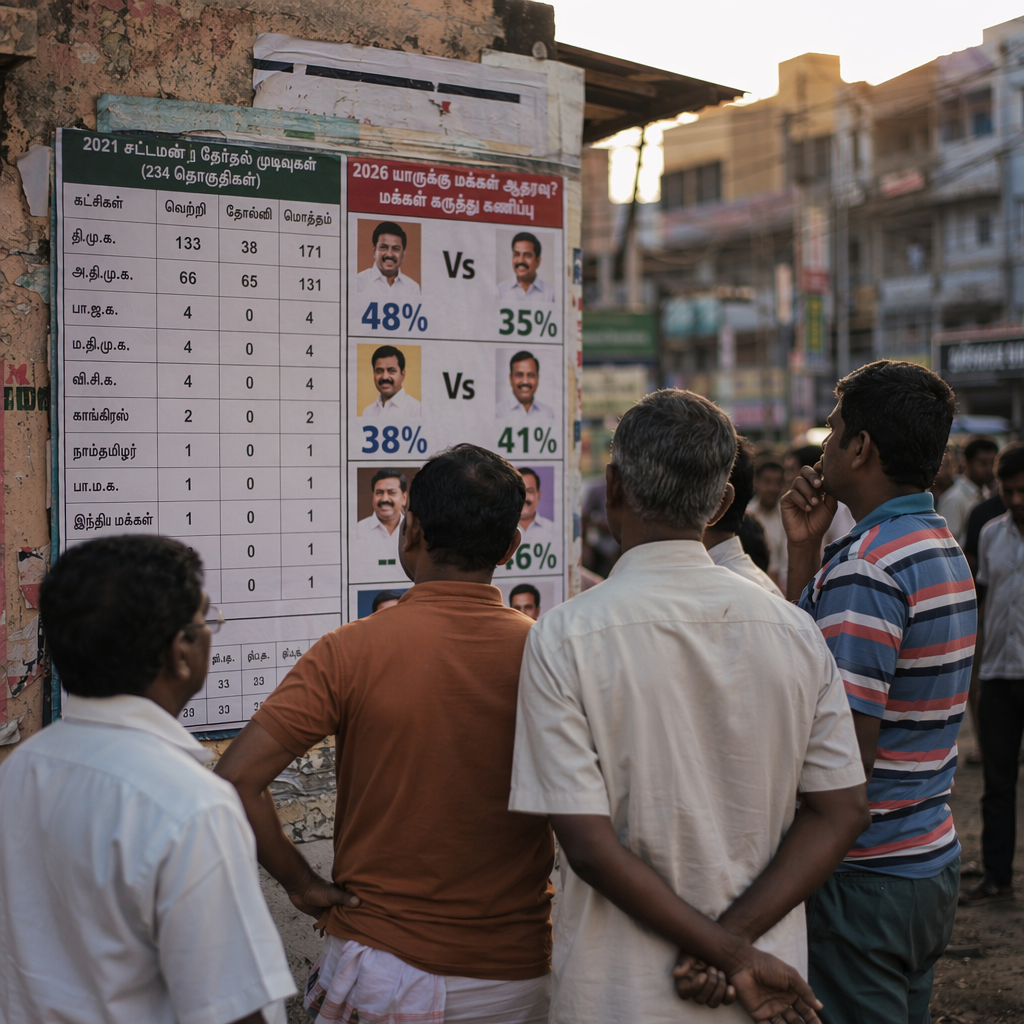
Tamil Nadu’s 2026 Assembly election will be fought for 234 seats in a House where a simple majority requires 118 MLAs, and that arithmetic is central to the discussion around actor Vijay’s Tamizhaga Vetri Kazhagam, or TVK. As of 2026, the party is preparing for its first state election after being announced in February 2024, making it a new entrant in one of India’s most closely watched regional political contests.
The phrase “TVK trust vote” has been used in public discussion in two different ways. The first refers to the electoral test facing TVK in the 2026 Tamil Nadu Assembly election. The second refers to a possible legislative confidence vote, which would arise only if no party or alliance has a clear majority after the election and the Governor asks a chief minister to prove majority support in the Assembly. No official trust vote involving TVK has taken place as of 2026, and no government notification has announced one.
That distinction matters because Tamil Nadu has a fixed Assembly size, a clear majority threshold and a recent history of decisive mandates. The current Assembly was elected in 2021, when the Dravida Munnetra Kazhagam-led alliance won a majority. According to the Election Commission of India’s 2021 results, the DMK won 133 of 234 seats, while the AIADMK won 66 seats. The BJP won 4 seats and the Congress won 18 seats as part of the DMK alliance. These numbers set the benchmark for any new party seeking influence in 2026.
TVK’s entry: what is officially known
Vijay announced the formation of Tamizhaga Vetri Kazhagam in February 2024 through an official statement and said the party would not contest the 2024 Lok Sabha election. The statement also said the party’s focus would be the 2026 Tamil Nadu Assembly election. This is the most concrete official timeline available for TVK’s electoral plans.
As of 2026, TVK is not represented in the Tamil Nadu Legislative Assembly, the Lok Sabha or the Rajya Sabha. It did not contest the 2024 general election, in which Tamil Nadu voted for 39 Lok Sabha seats. The DMK-led alliance won all 39 seats in Tamil Nadu in 2024, according to the Election Commission of India. That result showed the strength of the ruling alliance at the parliamentary level, though Assembly elections in Tamil Nadu have different candidate, constituency and alliance dynamics.
Reuters and other national and international news agencies reported in 2024 that Vijay’s move into politics added a prominent cinema figure to Tamil Nadu’s political field. Tamil Nadu has a long history of film personalities entering politics, including M.G. Ramachandran and J. Jayalalithaa. However, TVK’s electoral strength can be assessed only after it contests seats and its vote share is recorded by the Election Commission.
The trust-vote arithmetic in Tamil Nadu
A trust vote, also called a confidence vote, is a legislative test in which a chief minister must show majority support in the Assembly. In Tamil Nadu, the Assembly has 234 elected seats. If all seats are filled and voting conditions are straightforward, the majority mark is 118 MLAs.
As of 2026, any discussion about a TVK-linked trust vote depends on post-election numbers. If TVK wins seats and no alliance crosses 118, the party could become relevant to government formation. If one alliance wins a clear majority, a trust vote involving TVK would not arise unless political circumstances change later.
The constitutional process does not depend on media speculation. The Governor invites a leader who appears able to command majority support. If required, that leader must prove the majority on the Assembly floor. India’s Supreme Court has repeatedly held that majority tests are best conducted through a floor test in the legislature, rather than by claims made outside the House.
Key 2024–2026 data points shaping the TVK question
Several current data points help explain why TVK’s 2026 test is being closely watched. These figures are drawn from election records, government releases and publicly available demographic data.
- 234 Assembly seats, 2026: Tamil Nadu’s Assembly has 234 elected constituencies; the majority mark is 118.
- 39 Lok Sabha seats, 2024: Tamil Nadu voted for 39 parliamentary constituencies in the 2024 general election, according to the Election Commission of India.
- 39 of 39 seats, 2024: The DMK-led alliance won all Lok Sabha seats in Tamil Nadu in 2024, based on ECI results.
- 133 DMK Assembly seats, 2021: The DMK won 133 seats in the 2021 Assembly election, above the majority mark.
- 66 AIADMK Assembly seats, 2021: The AIADMK remained the largest opposition party after the 2021 election.
- Focus on 2026: TVK’s 2024 launch statement said the party would target the 2026 Tamil Nadu Assembly election and skip the 2024 Lok Sabha election.
Why 2026 is the first measurable test for TVK
Until a party contests an election, its public meetings, membership claims and media attention do not translate into verified electoral data. For TVK, the 2026 Assembly election is therefore the first formal test. Vote share, seat wins, deposits saved and regional performance will be the measurable indicators.
In Tamil Nadu, even small vote-share changes can affect constituency outcomes when alliances are tightly contested. However, the state’s recent elections have been shaped by broad alliances led by the DMK and AIADMK. The 2021 Assembly election and 2024 Lok Sabha election both showed the importance of alliance structures. Any assessment of TVK must therefore consider whether it contests alone, forms an alliance or supports another party after the election. As of 2026, only official announcements by the party or the Election Commission can confirm such arrangements.
The Assembly election will also be conducted under the Election Commission of India’s rules on candidate nomination, expenditure limits, symbols, campaign conduct and counting. Official vote share and seat totals will be known only after the ECI publishes constituency-wise results.
What a trust vote would require after the election
If the 2026 election produces a hung Assembly, the Governor may ask the leader claiming support to prove majority on the floor of the House. The voting process would be conducted inside the Assembly, and the Speaker’s role would be central to proceedings. The outcome would depend on MLAs present and voting, party positions and any applicable anti-defection rules.
For TVK, there are three factual scenarios in which the term “trust vote” could become relevant:
First, TVK wins enough seats to support or oppose a minority government. In that case, its MLAs could influence a confidence vote.
Second, TVK joins a pre-poll or post-poll alliance that forms the government. Its seats would be counted as part of the alliance strength.
Third, TVK remains outside government but votes on a confidence motion issue by issue, subject to party decisions and legislative rules.
None of these scenarios can be treated as fact until 2026 results are declared and formal legislative steps occur. As of 2026, there has been no Assembly floor test involving TVK because the party has not yet contested a Tamil Nadu Assembly election.
How Tamil Nadu’s recent mandates compare
Tamil Nadu has usually delivered clear governments in recent decades. In 2021, the DMK crossed the majority mark on its own with 133 seats. In 2016, the AIADMK won 134 seats, according to Election Commission records, allowing it to form the government without needing a post-election coalition majority. These past results reduce the historical frequency of hung Assembly scenarios in the state, though they do not rule out a different result in 2026.
The 2024 Lok Sabha result also reflected a strong alliance sweep for the DMK-led front. However, parliamentary elections are not identical to Assembly elections. Voter behaviour can differ between national and state contests, and constituency-level candidate selection often plays a larger role in Assembly polls.
For TVK, this means its electoral impact will be measured not only by statewide vote share but also by where its votes are concentrated. A party with evenly spread support may record vote share but win few seats, while a party with concentrated regional strength can convert a smaller statewide vote share into Assembly representation. These are standard patterns in first-past-the-post elections and will be visible only after official results.
The role of young voters and urban constituencies
Public attention around TVK has also focused on youth participation, social media campaigning and urban mobilisation. These factors are frequently discussed because Vijay has a large cinema audience and online following. But verified electoral influence requires polling-booth data, not social media metrics.
The Election Commission’s electoral rolls and turnout data will be important in 2026. Tamil Nadu recorded high voter participation in recent Assembly elections, and turnout patterns across urban and rural constituencies can affect close contests. Once the 2026 roll and turnout data are published, analysts will be able to compare TVK’s performance among constituencies with different demographic profiles.
As of 2026, no government data has identified a TVK vote bank because the party has not contested a state election. Claims about caste, regional or age-based support must therefore be treated cautiously unless supported by verifiable polling or post-election data.
What officials and institutions will decide
The Election Commission of India will oversee the election schedule, nominations, polling, counting and final results. The Tamil Nadu Legislative Assembly Secretariat would handle Assembly proceedings after the election, including any floor test if ordered. The Governor’s role would arise only in government formation or if majority support is disputed.
Any trust vote would be reported through official Assembly proceedings, government communications and verified news agency coverage. Until then, the only confirmed position is that TVK has announced its intention to contest the 2026 Tamil Nadu Assembly election and has not participated in a legislative confidence vote.
Why the wording matters for voters
Calling the 2026 election a “trust vote” on TVK is a political description, not a constitutional event. The actual trust vote, in legal and legislative terms, occurs only inside the Assembly when a government must prove majority support. The 2026 election will be TVK’s first electoral test; a floor test would be a separate event after results, if required.
This distinction is important for accurate public information. Voters will decide candidates and parties in 234 constituencies. The Election Commission will publish vote counts. Only after those numbers are known can any party’s role in government formation be assessed.
As of 2026, the confirmed facts are limited but significant: TVK was launched in 2024, skipped the 2024 Lok Sabha election, is targeting the 2026 Tamil Nadu Assembly election, and has no current representation in the Assembly. Whether it becomes a decisive factor in a trust vote depends entirely on the official 2026 results and the majority arithmetic in the 234-member House.
Sources: Reuters, Government releases, publicly available data.
Comments
Post a Comment