Surya Grahan: The science, dates and verified data behind solar eclipses
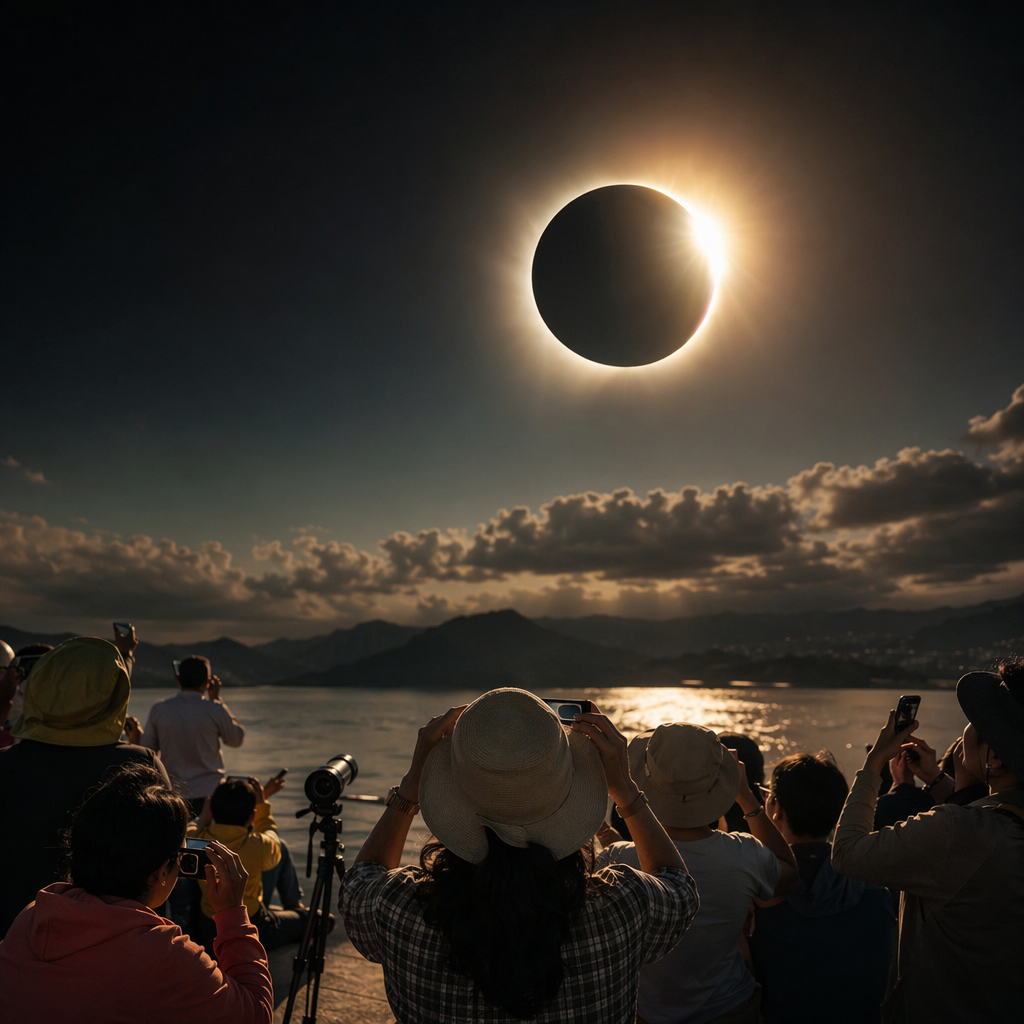
On 8 April 2024, a total solar eclipse crossed North America, and NASA estimated that about 31.6 million people in the United States lived inside the path of totality. The event became one of the most closely tracked astronomical events of the decade, with government agencies, universities and public-safety departments issuing detailed viewing, traffic and weather guidance ahead of the eclipse.
In Hindi and several Indian languages, a solar eclipse is commonly called Surya Grahan. It occurs when the Moon passes between the Sun and Earth, blocking all or part of the Sun’s visible disk from a specific region on Earth. The event is temporary, predictable and governed by orbital geometry. As of 2026, solar eclipses remain among the most widely observed astronomical events because they can be calculated centuries in advance but are visible only from limited geographic paths.
A solar eclipse does not occur every month because the Moon’s orbit is tilted by about 5 degrees relative to Earth’s orbit around the Sun, according to NASA’s eclipse education material. The Sun, Moon and Earth must align near one of the two points where the Moon’s orbit crosses Earth’s orbital plane. These alignment periods are known as eclipse seasons.
Types of Surya Grahan
There are four main categories of solar eclipse: total, partial, annular and hybrid. A total solar eclipse occurs when the Moon completely covers the Sun’s bright disk as seen from a narrow path on Earth. During totality, observers in that path may see the solar corona, the Sun’s outer atmosphere, if skies are clear.
A partial solar eclipse occurs when only part of the Sun is covered by the Moon. This is more common for observers outside the main path of a total or annular eclipse. An annular solar eclipse occurs when the Moon is too far from Earth to fully cover the Sun, leaving a bright ring, often called a “ring of fire”, around the Moon. A hybrid eclipse shifts between annular and total along different parts of its path because of Earth’s curvature and the changing apparent size of the Moon.
NASA and national meteorological agencies emphasise that the same eclipse can appear differently depending on location. For example, a person inside the central path may see totality, while another person hundreds of kilometres away may see only a partial eclipse.
Verified eclipse data for 2024 to 2026
The period from 2024 to 2026 includes several significant solar eclipses documented by NASA, the U.S. National Weather Service, the European Space Agency, timeanddate public astronomy data and government observatory releases. The most widely reported was the 8 April 2024 total solar eclipse, which crossed Mexico, the United States and Canada.
According to NASA’s 2024 eclipse data, the path of totality in the United States was about 115 miles, or 185 kilometres, wide. Totality first reached Mexico’s Pacific coast before moving through U.S. states including Texas, Arkansas, Missouri, Illinois, Indiana, Ohio, New York, Vermont and Maine, and then into Canada. NASA reported that the longest duration of totality was about 4 minutes 28 seconds near Torreón, Mexico.
The U.S. Census Bureau and NASA-linked public planning data showed that around 31.6 million people lived within the path of totality in the United States in 2024. Reuters reported before the event that millions more were expected to travel to the path, prompting state and local authorities to prepare for traffic congestion and emergency service demand.
Another important event was the 2 October 2024 annular solar eclipse. NASA listed its path across parts of the Pacific Ocean, southern Chile and southern Argentina. The eclipse was annular in a narrow corridor, while partial phases were visible across wider areas of South America and the Pacific region.
For 2025, NASA’s eclipse catalogue listed two partial solar eclipses: 29 March 2025 and 21 September 2025. The March 2025 partial eclipse was visible from parts of Europe, north-west Africa, Greenland, Iceland, north-east Canada and northern Russia, based on publicly available eclipse maps. The September 2025 partial eclipse was visible mainly from parts of the South Pacific, New Zealand and Antarctica.
As of 2026, two solar eclipses are listed for that year. NASA’s eclipse data shows an annular solar eclipse on 17 February 2026, with visibility across parts of Antarctica and the southern oceans. A major total solar eclipse on 12 August 2026 is projected to cross the Arctic, Greenland, Iceland, the Atlantic Ocean and parts of Spain. The European Space Agency and national astronomy organisations have highlighted the August 2026 eclipse because it will be the first total solar eclipse visible from mainland Spain since the early twentieth century.
- 8 April 2024: Total solar eclipse; about 31.6 million U.S. residents lived inside the path of totality, according to NASA and U.S. Census-linked estimates.
- 8 April 2024: Maximum totality lasted about 4 minutes 28 seconds near Torreón, Mexico, according to NASA.
- 2 October 2024: Annular solar eclipse visible along a path crossing parts of the Pacific, southern Chile and southern Argentina, according to NASA maps.
- 29 March 2025: Partial solar eclipse visible from parts of Europe, Greenland, north-west Africa and northern regions, according to NASA eclipse data.
- 21 September 2025: Partial solar eclipse visible mainly from parts of the South Pacific, New Zealand and Antarctica, according to NASA and public astronomy data.
- 12 August 2026: Total solar eclipse expected across Greenland, Iceland, the Atlantic and Spain, according to NASA and European astronomy agencies.
Why solar eclipses are predictable
Solar eclipses follow repeatable orbital cycles. One of the best-known is the Saros cycle, a period of about 18 years, 11 days and 8 hours after which similar eclipses occur. The Saros cycle is used by astronomers to classify eclipse families, although each eclipse in a Saros series is visible from a different path on Earth because of the extra one-third day in the cycle.
Government and scientific agencies publish eclipse predictions using celestial mechanics, lunar orbit data and Earth rotation models. NASA’s eclipse catalogues, for example, give the date, time, type, magnitude and geographic path of eclipses. These are not weather forecasts; they are astronomical calculations. Cloud cover and visibility conditions still depend on local weather at the time of the event.
Safety rules for viewing Surya Grahan
Public health and science agencies repeatedly warn that looking directly at the Sun can cause permanent eye injury. The danger applies during partial phases of any solar eclipse and during annular eclipses. NASA, the American Astronomical Society and public health authorities state that ordinary sunglasses are not safe for viewing the Sun.
Safe solar viewers must comply with the international safety standard ISO 12312-2. Eclipse glasses and handheld viewers that meet this standard reduce visible sunlight and harmful ultraviolet and infrared radiation to safe levels. During a total solar eclipse, viewers in the narrow path of totality may look without eye protection only during the brief period when the Sun is completely covered. Eye protection must be used again as soon as any part of the bright Sun reappears.
Indirect viewing methods, such as pinhole projectors, are also recommended by science agencies. These methods allow people to observe the shape of the eclipsed Sun projected onto a surface without looking directly at it.
Impact on transport, tourism and public services
Large eclipses can affect public services because they draw crowds to narrow viewing corridors. Reuters reported in April 2024 that U.S. cities and states along the total eclipse path prepared for large visitor numbers, with authorities advising people to plan for heavy traffic, fuel demand and mobile-network congestion. Several U.S. states issued emergency or disaster-related administrative measures before the 2024 eclipse to help manage transport and public safety operations.
The 2024 eclipse also created measurable tourism activity. Local government tourism offices in the United States and Canada promoted viewing events, while schools, museums and science centres organised public programmes. These activities were tied to the short duration of totality and the limited geographic path, which concentrated travel into specific areas.
Public agencies generally treat eclipses as planned natural events rather than emergencies. The main operational issues are crowd management, road safety, emergency response access and public communication. Weather agencies also provide cloud-cover and forecast updates because clear skies determine whether observers can see the eclipse.
Solar eclipses and scientific research
Total solar eclipses have long been used for scientific observation because the Moon blocks the Sun’s bright surface and makes the corona easier to study from the ground. During the 2024 total eclipse, NASA supported multiple research projects, including studies of the solar corona, Earth’s ionosphere and animal behaviour during sudden daylight changes. NASA also used aircraft, ground stations and public science participation in its eclipse-related research programmes.
The Sun was approaching a period of high activity around 2024 and 2025 in Solar Cycle 25, according to NASA and the U.S. National Oceanic and Atmospheric Administration. NOAA’s Space Weather Prediction Center said in 2024 that solar maximum conditions were underway, increasing scientific interest in observations of the corona and solar activity. This context made the 2024 eclipse particularly useful for researchers studying the Sun’s outer atmosphere.
Solar eclipse data also supports atmospheric studies. When sunlight decreases rapidly during an eclipse, temperature, wind and ionospheric conditions can change temporarily. Universities and government agencies often deploy instruments to record these changes. The results help researchers compare eclipse effects across locations and weather conditions.
Surya Grahan in India and public information
India has a long history of public interest in Surya Grahan. The India Meteorological Department, the Astronomical Society of India, planetariums and science communication agencies typically release viewing guidance when an eclipse is visible from the country. The Government of India’s science and education bodies have repeatedly advised the public to use certified solar filters or indirect viewing methods.
Not every solar eclipse is visible from India. Visibility depends on the Moon’s shadow path and Earth’s rotation at the time of the eclipse. For eclipses that occur over the Americas, the Pacific or polar regions, observers in India may see no eclipse at all. Public astronomy maps are therefore important for verifying whether a specific Surya Grahan is visible from a particular city.
As of 2026, the major total eclipse of 12 August 2026 is not primarily an India-visible event. Its path is listed across Greenland, Iceland, the Atlantic and Spain. Observers outside the path may see partial phases only if their location falls within the wider penumbral shadow, according to NASA eclipse maps.
Common factual misunderstandings
A solar eclipse is not visible from the entire daytime side of Earth. Only locations within the Moon’s shadow can see it, and totality is restricted to a narrow central path. Another common misunderstanding is that an eclipse changes the Sun itself. The Sun continues emitting light and radiation normally; the Moon temporarily blocks the view from certain locations on Earth.
Solar eclipses also do not last for hours at totality. The complete event, including partial phases, may last several hours at one location, but totality usually lasts only a few minutes. NASA’s 2024 data showed a maximum totality of about 4 minutes 28 seconds for the April 2024 eclipse, while many locations experienced shorter totality.
Weather remains a separate factor. Astronomical calculations determine where the eclipse will occur, but clouds can block the view. This is why meteorological agencies publish forecasts in the days before an eclipse, and why observers often travel to areas with historically clearer skies.
Upcoming relevance through 2026
The 2024 to 2026 period shows why Surya Grahan remains important for science communication and public planning. The 2024 North American total eclipse demonstrated the scale of public participation, with tens of millions living inside the U.S. path and many more in partial-eclipse regions. The 2025 eclipses are partial events, but they remain relevant for education and safe-viewing campaigns. The 2026 total eclipse is expected to be a major European astronomy event because of its path across Iceland and Spain.
For readers tracking future eclipses, the most reliable sources are national space agencies, official observatories, meteorological agencies and recognised astronomical organisations. These bodies provide maps, timings, safety guidance and visibility details based on verified calculations.
Sources: Reuters, Government releases, publicly available data.
Comments
Post a Comment