Smriti Irani: Political Career, Ministerial Record and 2024 Election Outcome
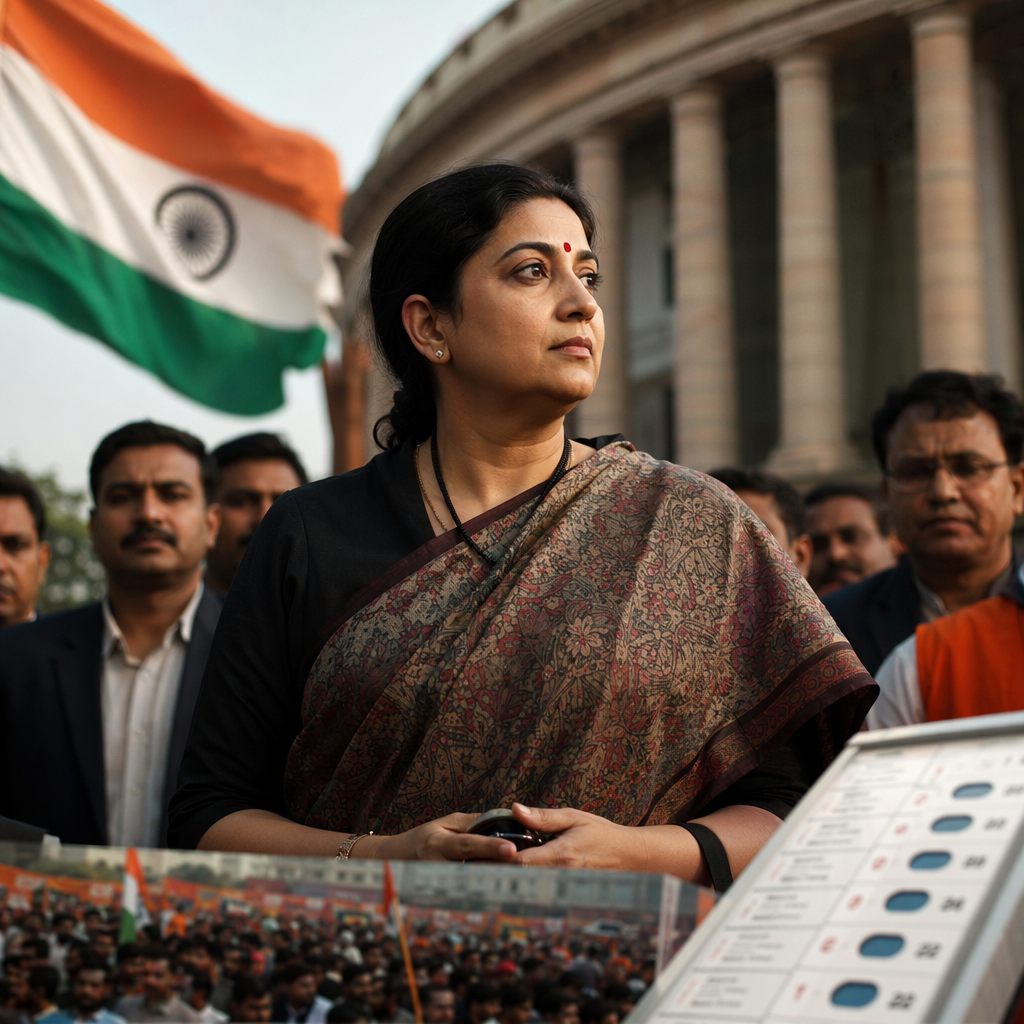
As of 2026, Smriti Zubin Irani remains one of India’s most widely recognised Bharatiya Janata Party (BJP) leaders, despite losing the Amethi Lok Sabha seat in the 2024 general election. Her political profile has been shaped by high-visibility electoral contests, ministerial assignments in major Union ministries, and her role in the BJP’s national campaign structure.
In the 2024 Lok Sabha election, Irani contested from Amethi in Uttar Pradesh and received 3,72,032 votes, according to the Election Commission of India’s published constituency results. Congress candidate Kishori Lal Sharma won the seat with 5,39,228 votes, defeating Irani by 1,67,196 votes. The result was a significant reversal from 2019, when Irani defeated Congress leader Rahul Gandhi in the same constituency by 55,120 votes, according to Election Commission data.
Irani’s public career spans television, party organisation, Parliament and the Union Council of Ministers. Her ministerial record includes the Human Resource Development Ministry, Textiles Ministry, Women and Child Development Ministry, Minority Affairs Ministry, and Information and Broadcasting portfolio. Government releases and parliamentary records show that she has held cabinet-level responsibilities during key policy periods under Prime Minister Narendra Modi’s government.
Early life and entry into public life
Smriti Irani was born on 23 March 1976. Before entering politics, she became a well-known television actor, particularly through the Hindi television serial Kyunki Saas Bhi Kabhi Bahu Thi, which made her a household name in the early 2000s. Her transition from entertainment to politics followed a route taken by several Indian public figures, but her rise within the BJP was tied to organisational work and repeated electoral campaigns.
Irani joined the BJP in the early 2000s and gradually took on party roles. She later served in the Rajya Sabha before becoming a Lok Sabha MP. Her early political career included contesting against senior Congress leaders, which placed her in nationally watched contests even before she held cabinet office.
Parliamentary career and the Amethi contests
Amethi has long been one of India’s most closely watched parliamentary constituencies because of its association with the Nehru-Gandhi family. Irani first contested from Amethi in the 2014 Lok Sabha election against Rahul Gandhi. According to Election Commission data, Gandhi won the seat in 2014, while Irani finished second. Even after losing, she continued to visit the constituency and remained politically active there.
In 2019, Irani returned to Amethi as the BJP candidate. The Election Commission’s 2019 results show that Irani secured 4,68,514 votes, while Rahul Gandhi received 4,13,394 votes. Her victory margin was 55,120 votes. The result received national attention because Gandhi was then Congress president and Amethi had been represented by members of his family for many years.
The 2024 election produced the opposite outcome. Congress nominated Kishori Lal Sharma, a long-time party worker associated with Amethi and Rae Bareli. According to the Election Commission of India’s 2024 results, Sharma won with 5,39,228 votes, while Irani received 3,72,032 votes. The constituency recorded a clear change in voter preference compared with 2019.
Key election figures from Amethi:
- 2019: Smriti Irani won Amethi with 4,68,514 votes; Rahul Gandhi received 4,13,394 votes; margin 55,120 votes, according to the Election Commission of India.
- 2024: Kishori Lal Sharma won Amethi with 5,39,228 votes; Smriti Irani received 3,72,032 votes; margin 1,67,196 votes, according to Election Commission data.
- 2024 national result: The BJP won 240 Lok Sabha seats, while the National Democratic Alliance crossed the majority mark with 293 seats, according to Election Commission results reported by Reuters in June 2024.
- 2024 opposition tally: The Congress won 99 seats in the Lok Sabha election, according to the Election Commission of India’s final results.
Role in the Union government
Smriti Irani entered the Union Council of Ministers after the BJP-led National Democratic Alliance came to power in 2014. She was appointed Minister of Human Resource Development in May 2014, a high-profile portfolio responsible at that time for school education, higher education, and national education institutions. The ministry was later renamed the Ministry of Education in 2020, after Irani had moved to other portfolios.
Her tenure in Human Resource Development was marked by frequent parliamentary debate and public attention, including discussions on university governance, curriculum issues and institutional autonomy. Government records show she served in the role until 2016, when she was moved to the Textiles Ministry.
As Textiles Minister, Irani handled a sector that is one of India’s largest employers. The textiles and apparel sector has been repeatedly described by the Government of India as a major source of employment, particularly for women workers. During her time in the ministry, government schemes focused on textile clusters, handloom promotion, export competitiveness and support for weavers.
Irani also held the Information and Broadcasting portfolio for a period, a ministry that oversees government communication, broadcasting policy and public information bodies. She later served as Minister of Women and Child Development, a portfolio connected to child nutrition, protection, women’s safety, early childhood care and welfare schemes such as Anganwadi services.
Women and Child Development Ministry
Irani became Minister of Women and Child Development in 2019. The ministry manages programmes including Mission Saksham Anganwadi and Poshan 2.0, Mission Shakti and Mission Vatsalya. These programmes cover nutrition, women’s safety, child protection and institutional support for vulnerable groups.
Government budget documents show that the Ministry of Women and Child Development was allocated ₹26,092.19 crore for 2024–25 in the Union Budget. This allocation covered major centrally sponsored schemes, including Saksham Anganwadi and Poshan 2.0, Mission Shakti and Mission Vatsalya. The figures were published in Union government budget documents for financial year 2024–25.
Nutrition has remained a central focus of the ministry. The National Family Health Survey-5, released by the Government of India for 2019–21, reported that 35.5% of children under five were stunted and 19.3% were wasted nationally. Although those survey figures pre-date 2024, they formed the statistical background for nutrition-related schemes that continued into 2024–25. Government releases in 2024 continued to refer to Poshan Tracker and Anganwadi digitisation as monitoring tools for service delivery.
As of 2026, the Women and Child Development portfolio remains one of the most data-driven social ministries in India because it tracks beneficiaries through government platforms and reports expenditure through Union Budget documents. Irani’s tenure placed her at the centre of these programmes during the second Modi government.
Minority Affairs portfolio
In July 2022, Irani was given additional charge of the Ministry of Minority Affairs after the resignation of Mukhtar Abbas Naqvi from the Union Council of Ministers. The ministry administers schemes for notified minority communities, including education-related scholarships, skills programmes and infrastructure projects in minority-concentrated areas.
Union Budget documents show that the Ministry of Minority Affairs received ₹3,183.24 crore for 2024–25. The allocation was part of the government’s annual expenditure plan presented to Parliament. The ministry’s schemes and budgetary trends have been the subject of parliamentary questions and public policy discussions, particularly around scholarship funding and programme restructuring.
Irani continued to hold Women and Child Development and Minority Affairs until the 2024 general election period. After the election, she was not included in the Union Council of Ministers sworn in on 9 June 2024, following the formation of the third Modi government. Reuters reported that Prime Minister Narendra Modi took oath for a third term on that date, leading an NDA government after the BJP fell short of a single-party majority.
Position after the 2024 election
The 2024 Lok Sabha election changed Irani’s parliamentary status. With the loss in Amethi, she ceased to be a Lok Sabha member. She also did not continue as a Union minister in the new government formed in June 2024. However, she remained a senior BJP figure with past cabinet experience and a national profile built over two decades.
Reuters reported in June 2024 that the BJP won 240 seats, down from 303 seats in 2019. The NDA won 293 seats, enough to form the government in the 543-member Lok Sabha. The Congress increased its tally to 99 seats in 2024, according to Election Commission data. These results provide the broader political context for Irani’s defeat in Amethi and the BJP’s reduced majority.
Irani publicly accepted the Amethi result after the counting of votes. In remarks reported by Indian news agencies and broadcasters in June 2024, she said she would continue to serve the people of Amethi. Her statement followed the formal declaration of results by the Election Commission.
Public communication and political image
Irani has been known for direct political communication, both in Parliament and during election campaigns. She frequently spoke on issues involving the Congress leadership, women’s welfare, social policy and governance. As a minister, her public statements were often issued through official ministry channels and the Press Information Bureau.
Her communication style also extended to social media. As of 2026, major Indian political leaders, including Irani, use digital platforms for campaign messaging, government announcements and constituency outreach. Publicly visible follower counts change frequently and are platform-dependent; therefore, verified current figures should be read directly from the relevant official social media profiles.
During her ministerial tenure, official government releases attributed to her covered issues such as nutrition campaigns, child protection, women’s safety initiatives and minority welfare. These releases form a documented record of policy announcements, review meetings and scheme implementation updates.
Major policy areas associated with Irani
Irani’s national political career is associated with several policy areas because of the ministries she led. In education, she was part of the government during a period when higher education and university administration were under intense public scrutiny. In textiles, she handled a labour-intensive sector with export and employment implications. In women and child development, she oversaw schemes connected to nutrition, Anganwadi services, child protection and women’s safety.
The 2024–25 allocation of ₹26,092.19 crore to the Women and Child Development Ministry is one of the most relevant recent figures linked to the portfolio she held before the election. Another relevant figure is the ₹3,183.24 crore allocation for the Minority Affairs Ministry in 2024–25. Both figures are from Union Budget documents and show the scale of programmes administered by the ministries she led before leaving office.
Her electoral record also remains central to assessments of her public career. The shift from winning Amethi by 55,120 votes in 2019 to losing it by 1,67,196 votes in 2024 is documented by the Election Commission and is one of the clearest measurable changes in her political trajectory.
Current status as of 2026
As of 2026, Smriti Irani is not a member of the Lok Sabha and is not listed as a Union minister in the Government of India’s Council of Ministers formed after the 2024 general election. Her most recent parliamentary contest was the 2024 Amethi election, where she finished second. She remains associated with the BJP and continues to be identified with her previous cabinet roles.
Her political career is notable for the range of offices she held and the scale of elections she contested. The factual record includes a 2019 victory over Rahul Gandhi in Amethi, a 2024 defeat to Kishori Lal Sharma, and cabinet responsibility for ministries with large welfare and development budgets. These data points, drawn from the Election Commission, Union Budget documents, government releases and Reuters reporting, define her public profile up to 2026.
Sources: Reuters, Government releases, publicly available data.
Comments
Post a Comment