Self-Enumeration 2027: What Digital Census Participation Could Mean for Households and Governments
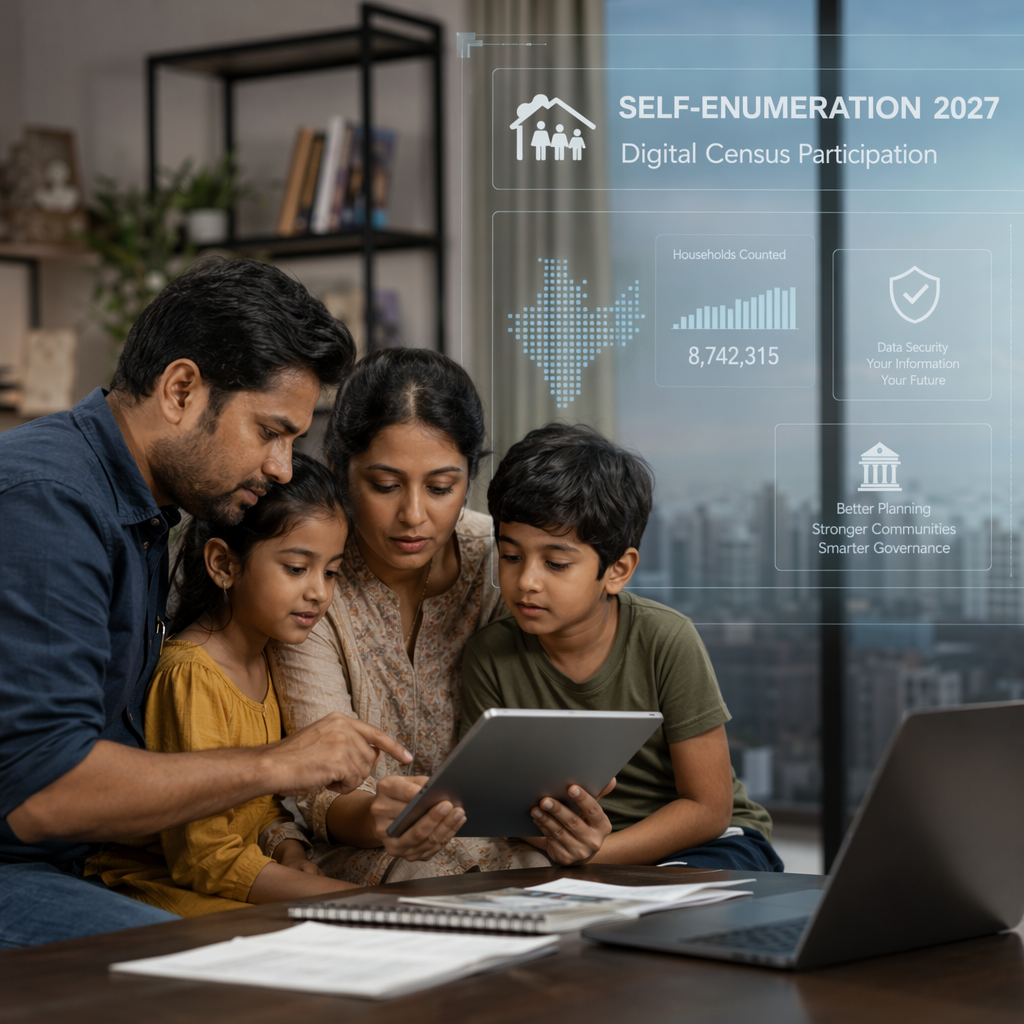
As of 2026, more than 5.8 billion people were using the internet worldwide, according to estimates published by the International Telecommunication Union for 2024 and updated through recent UN digital-development reporting. That level of connectivity is reshaping how governments collect population data. One of the clearest examples is self-enumeration — a census method that allows households to submit their own information, usually through an online portal, mobile application, mailed paper form, or assisted digital channel.
Self-enumeration is expected to be a major feature of census operations planned around 2027 in countries updating their population registers or conducting full national counts. The method is not new, but its scale is changing. National statistical offices are increasingly using digital forms, identity verification systems, and administrative records to reduce field visits and speed up publication of results.
The central issue for 2027 is practical: how to collect accurate, inclusive population data while dealing with cybersecurity risks, digital exclusion, migration, housing changes, and public trust. For governments, census data affects parliamentary boundaries, public-service planning, school capacity, health budgets, transport investment, housing policy, and emergency response. For residents, self-enumeration changes the experience from waiting for a fieldworker to answering a structured questionnaire directly.
What self-enumeration means
Self-enumeration is a census collection process in which a household or individual completes the census questionnaire without an enumerator recording the answers face to face. In most modern systems, the government sends an invitation letter, access code, identity-linked login, or household reference number. Respondents then provide information on residents, age, sex, relationship, education, employment, housing, disability, migration, language, and other legally approved census topics.
The approach can be digital-first or mixed-mode. A digital-first census asks most households to respond online, while providing paper forms, call-centre support, or field follow-up for people unable or unwilling to use the internet. A mixed-mode system uses online forms, telephone interviews, paper questionnaires, and in-person visits at the same time.
National statistical offices use self-enumeration to improve operational efficiency, but the method does not remove the need for fieldwork. Non-response follow-up remains a core census function. Enumerators are still required for remote areas, institutional populations, homelessness counts, people with limited literacy, and households that do not respond by the deadline.
Why 2027 matters for census planning
Census cycles vary by country, but many governments plan major enumeration exercises every five or ten years. The year 2027 falls within a period in which countries are adapting lessons from the 2020 round of censuses and preparing for the next cycle of digital data collection.
India, the world’s most populous country, has not conducted a full census since 2011. Government statements have indicated preparation for a future census with digital components, although official dates and procedures must be confirmed through formal notifications. India’s Registrar General and Census Commissioner remains the legal authority for census operations under the Census Act, 1948. India’s population was estimated by the United Nations at more than 1.4 billion in 2024, making any future enumeration one of the largest statistical exercises in the world.
Other countries have already shown how self-enumeration can work at scale. The United States Census Bureau reported that the 2020 Census allowed online, phone, and mail responses, with internet self-response becoming a major collection channel. The UK’s Office for National Statistics said the 2021 Census in England and Wales was designed as “digital-first,” with most households encouraged to respond online. Statistics Canada also used online response as the primary channel for the 2021 Census.
By 2027, countries adopting similar systems are likely to focus on three measurable goals: increasing online response rates, lowering the cost of repeated field visits, and improving the speed at which preliminary data can be processed and published.
Recent data shaping self-enumeration policy
As of 2026, census digitisation is being shaped by population growth, internet access, smartphone use, and public-sector digital identity systems. Recent official and institutional data show why governments are moving cautiously but steadily toward self-response models.
- Global population: The United Nations estimated the world population at about 8.1 billion in 2024, increasing the scale and cost of traditional census operations.
- Internet access: The International Telecommunication Union reported that 5.5 billion people were using the internet in 2024, equal to roughly 68% of the global population.
- India’s digital base: The Telecom Regulatory Authority of India reported more than 954 million internet subscribers in India in 2024, a key indicator for any future online self-enumeration component.
- Mobile connectivity: GSMA’s 2025 mobile economy reporting said mobile internet adoption continued rising, but billions remained affected by the “usage gap” — people covered by mobile broadband networks who were not using mobile internet.
- Cybersecurity context: Government cybersecurity agencies, including the U.S. Cybersecurity and Infrastructure Security Agency and the UK National Cyber Security Centre, continued issuing public warnings in 2024 and 2025 about phishing, impersonation, and data-security threats affecting public services.
- Administrative data: OECD and national statistical agencies reported in 2024–2025 that administrative records are increasingly used to support census operations, including address registers and population estimates.
These figures show why self-enumeration is not simply a technology project. It depends on connectivity, digital literacy, legal safeguards, awareness campaigns, and the ability of statistical agencies to protect personal information.
How a self-enumeration census typically works
A self-enumeration system usually begins with an address register or household listing. The statistical office identifies dwellings, assigns access credentials, and sends official instructions. In an online model, each household receives a secure code or login path. The respondent enters household details and confirms who usually lives at the address on the census reference date.
The census reference date is important because it fixes the count at a specific point in time. People who move before or after that date must still be counted according to the rules set by the statistical office. This helps prevent double counting or omissions.
After submission, the system checks for missing answers, inconsistent ages, duplicate records, or address errors. Statistical staff may contact households for clarification where permitted by law. Households that do not respond are added to a follow-up list. Fieldworkers may visit those addresses, provide assistance, or complete the questionnaire through an interview.
In countries with strong civil registration and administrative databases, self-enumeration may be supported by pre-filled information. Residents then confirm or correct existing data. This reduces respondent burden but requires strict legal controls and transparency about data use.
Benefits documented by recent census operations
The main operational benefit of self-enumeration is that it can reduce the number of visits required by field staff. When households respond online before fieldwork begins, enumerators can focus on non-response and hard-to-reach groups.
The U.S. Census Bureau’s 2020 operation demonstrated the importance of online response at national scale. The Bureau reported that self-response was available by internet, phone, and mail, and that the final count relied on both self-response and non-response follow-up. The UK Office for National Statistics reported that the 2021 Census in England and Wales achieved high online participation under its digital-first model, while still offering paper questionnaires and support services.
Self-enumeration can also improve data-processing speed. Digital forms reduce manual data entry and can apply validation checks while the respondent is completing the questionnaire. For example, a form can flag an impossible birth year or a missing household relationship before submission. That does not guarantee accuracy, but it reduces certain types of processing error.
Another benefit is accessibility for people who prefer to complete forms privately or outside office hours. Online census portals can operate continuously during the response period. However, accessibility depends on language availability, disability support, device compatibility, and public awareness.
Risks: exclusion, misinformation and cybersecurity
Self-enumeration also creates risks that governments must address before 2027. The first is exclusion. Internet access is uneven by income, age, gender, disability, region, and education. ITU data for 2024 showed that about one-third of the global population remained offline. Even where mobile broadband coverage exists, people may lack affordable data, digital skills, or confidence using official websites.
The second risk is misinformation. During census periods, false messages can discourage participation or claim that census data will be used for unrelated enforcement actions. Statistical agencies usually respond through official advertising, helplines, published privacy rules, and partnerships with local authorities.
The third risk is cybersecurity. Census systems collect sensitive personal and household information. Governments must protect portals from phishing, fake websites, credential theft, denial-of-service attacks, and unauthorised access. Public agencies in the United States, United Kingdom, European Union, India and other jurisdictions issued multiple cybersecurity advisories during 2024 and 2025 warning about impersonation and online fraud affecting government services. A self-enumeration census must therefore make official web addresses, authentication methods, and reporting channels clear to the public.
Privacy and legal safeguards
Census confidentiality is normally protected by law. Statistical agencies generally publish aggregated data, not identifiable household records. In many countries, census staff face legal penalties for unlawful disclosure of personal information. The details differ by jurisdiction, but the principle is consistent: census data is collected for statistical purposes and protected under census or statistics legislation.
For self-enumeration in 2027, privacy safeguards are likely to focus on encryption, access controls, audit logs, data minimisation, and separation between statistical data and other government functions. Where digital identity is used, governments must explain whether identity credentials are used only for authentication or are linked to the statistical dataset.
Transparency is central to public compliance. Official census websites typically publish the legal authority for the census, the questions asked, how the data will be used, how long records are retained, and how households can verify that an invitation is genuine.
What households may need to prepare
Although procedures differ by country, households using self-enumeration generally need basic information about all usual residents. This may include names, ages, sex, marital status, relationship to the head or reference person, education, employment, migration history, and housing details such as dwelling type and number of rooms.
Households should use only official census websites, government-issued codes, or verified helplines. They should not submit census information through links in unofficial messages or social media posts. Most census agencies do not ask for bank passwords, payment card details, or one-time banking codes.
For people without internet access, governments usually provide alternatives. These can include paper forms, telephone assistance, community help centres, or visits from authorised enumerators carrying official identification.
What governments must publish before launch
A credible self-enumeration programme depends on clear public information before the census date. Government releases should state the legal basis, the reference date, who must respond, available response channels, deadlines, penalties for non-response where applicable, data-protection rules, and how to identify authorised census workers.
Public testing is also important. Several statistical agencies conduct pilot censuses or rehearsal operations before a national launch. These tests measure questionnaire design, server capacity, address accuracy, helpdesk demand, language support, and field follow-up procedures. Results from pilots are often used to adjust the final operation.
As of 2026, the direction of census operations is clear: self-enumeration is becoming a standard part of modern population counts, but it is not a complete replacement for field enumeration. Its success in 2027 will depend on how well governments combine digital access with inclusion, legal safeguards, and transparent communication.
For households, the practical change is straightforward: census participation may increasingly begin with an official letter, access code, or secure government portal rather than a knock on the door. For national statistical systems, the larger challenge is ensuring that faster collection does not leave out people who are offline, mobile, homeless, elderly, disabled, or living in remote areas.
Sources: Reuters, Government releases, publicly available data.
Comments
Post a Comment