Royal Enfield in 2026: Sales, Exports and the Push Beyond Classic Motorcycles
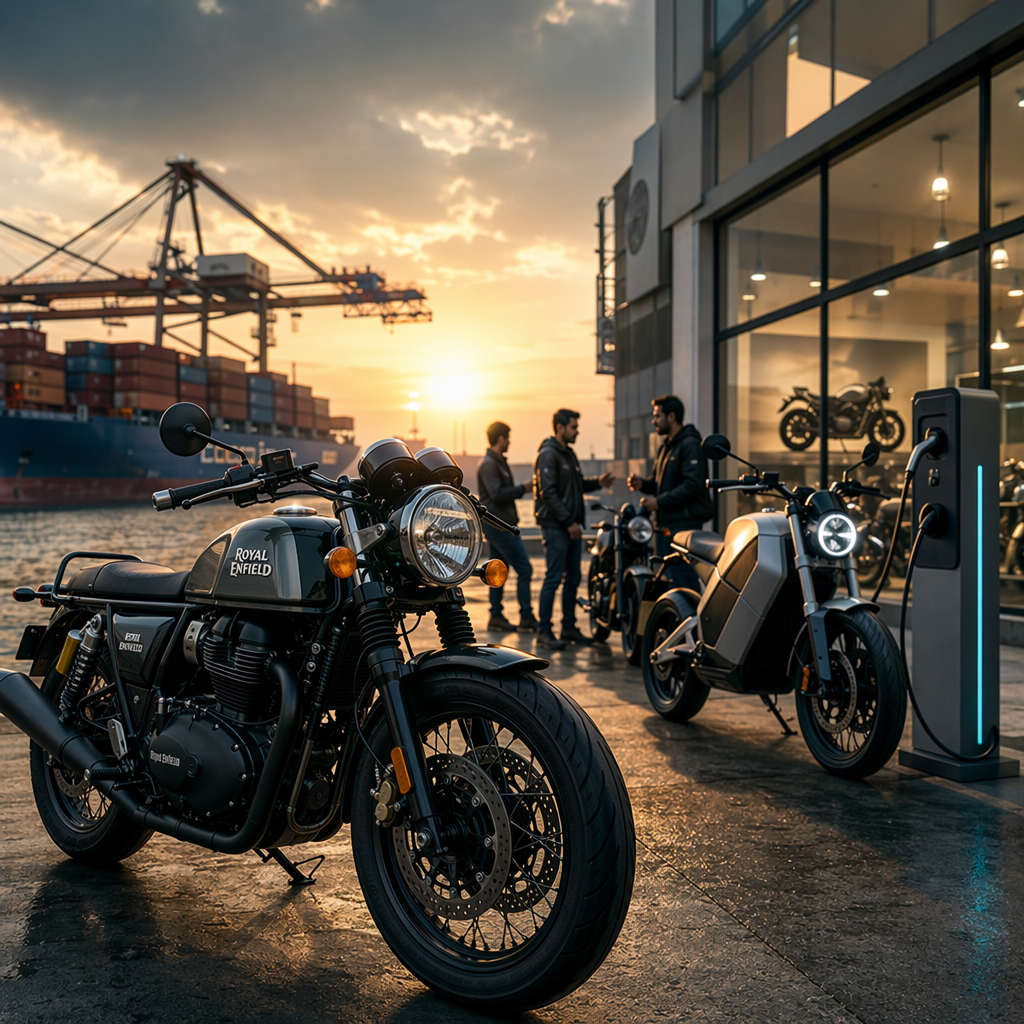
Royal Enfield sold 944,387 motorcycles in the financial year 2023–24, according to annual results released by its parent company, Eicher Motors. That figure made the Chennai-based motorcycle maker one of the most closely watched brands in the global mid-size motorcycle segment, where it competes in the 250cc–750cc category with models such as the Classic, Hunter, Bullet, Himalayan, Meteor, Super Meteor, Shotgun and the 650 Twins.
As of 2026, Royal Enfield remains a subsidiary of Eicher Motors Ltd, a publicly listed Indian company. Its motorcycle business is central to Eicher’s financial performance and is also part of India’s wider two-wheeler manufacturing and export ecosystem. The company’s strategy is based on a combination of domestic volume, global retail expansion, and a gradual entry into electric motorcycles.
Company Position and Ownership
Royal Enfield is owned by Eicher Motors Ltd, headquartered in Gurugram, India, while Royal Enfield’s main product development and manufacturing base is in and around Chennai, Tamil Nadu. The brand traces its origins to the Royal Enfield name used in Britain in the early 20th century, but the current motorcycle business is operated by Eicher Motors in India.
In corporate filings and investor communications, Eicher Motors identifies Royal Enfield as its motorcycle division. Eicher also has a joint venture with Volvo Group through VE Commercial Vehicles for trucks and buses, but Royal Enfield is reported separately as a motorcycle business in company disclosures.
For investors and industry analysts, Royal Enfield is important because it operates in a relatively specialised section of the motorcycle market. It is not mainly a commuter-bike manufacturer. Instead, it focuses on motorcycles positioned above India’s mass-market 100cc–200cc commuter segment and below the large-capacity premium segment dominated by global manufacturers.
2024 Sales: A Large Domestic Base
The most recent complete annual sales data released by Eicher Motors shows that Royal Enfield sold 944,387 motorcycles in FY2023–24, compared with 834,895 motorcycles in FY2022–23. This was reported in Eicher Motors’ annual disclosures for the year ended March 31, 2024.
That performance was supported by the Indian market, where Royal Enfield has a deep dealership and service network. The domestic business remains the company’s main source of volume. In FY2023–24, the company reported domestic sales of 856,926 motorcycles, while exports were 87,461 motorcycles. These figures show that exports represented less than one-tenth of Royal Enfield’s annual motorcycle sales in that financial year.
India’s broader two-wheeler market has also been recovering from the disruption seen during the COVID-19 period and the subsequent price increases linked to emissions and safety regulations. According to data published by the Society of Indian Automobile Manufacturers and industry releases cited by Reuters, India remained the world’s largest two-wheeler market by volume in 2024, with motorcycles and scooters forming the largest portion of domestic vehicle sales.
Financial Performance in 2024
Eicher Motors reported consolidated revenue from operations of ₹16,536 crore in FY2023–24, compared with ₹14,442 crore in FY2022–23. The company also reported a consolidated profit after tax of ₹4,001 crore in FY2023–24, up from ₹2,914 crore in the previous year, according to its annual report and stock-exchange filings.
Royal Enfield’s motorcycle business was the major contributor to Eicher Motors’ revenue. The company has also reported quarterly results during 2024 and 2025 to Indian stock exchanges, including the National Stock Exchange and BSE. These filings provide updated data on sales volume, revenue and profit, and they are used by analysts to track demand trends for Royal Enfield models.
In a Reuters report published in 2024 on Eicher Motors’ results, analysts noted that demand for Royal Enfield motorcycles was supported by launches in the mid-size segment and continuing sales of established models. Reuters has also reported that competition in India’s premium motorcycle category has intensified, with companies including Bajaj Auto, Triumph, Harley-Davidson’s India partnership, Hero MotoCorp and others launching new products.
Key 2024–2026 Data Points
Publicly available company and industry data show the main numbers behind Royal Enfield’s position as of 2026:
- 944,387 motorcycles sold in FY2023–24, according to Eicher Motors’ annual report.
- 856,926 domestic motorcycle sales in FY2023–24, based on Eicher Motors’ annual disclosures.
- 87,461 motorcycles exported in FY2023–24, according to Eicher Motors’ reported sales data.
- ₹16,536 crore consolidated revenue from operations in FY2023–24, reported by Eicher Motors.
- ₹4,001 crore consolidated profit after tax in FY2023–24, according to Eicher Motors’ annual results.
- Multiple manufacturing facilities in Tamil Nadu, including plants at Oragadam and Vallam Vadagal, as listed by the company in public information.
Manufacturing Footprint in India
Royal Enfield manufactures motorcycles primarily in Tamil Nadu. Its key facilities include the Oragadam plant and the Vallam Vadagal facility near Chennai. The company also operates a technology centre in the United Kingdom, which supports product development, testing and engineering work for global models.
The choice of Tamil Nadu is significant because the state is one of India’s major automotive manufacturing hubs. Government of Tamil Nadu investment documents and industry data identify the Chennai region as a centre for two-wheeler, car, commercial vehicle and component manufacturing. Royal Enfield’s operations are part of that industrial cluster, which includes suppliers, logistics operators and export infrastructure.
The company’s manufacturing model supports both domestic sales and export shipments. Motorcycles built in India are sold through the Indian dealership network and exported to international markets. In some overseas markets, Royal Enfield has also developed local assembly or distribution arrangements, depending on regulations and market size.
Model Range: Classic, Hunter, Himalayan and 650 Platform
Royal Enfield’s portfolio is built around a small number of engine platforms used across different models. The Classic and Bullet names remain among the company’s most recognisable products in India. The Hunter 350 was introduced as a lighter, urban-focused model and has been marketed to younger riders and first-time Royal Enfield customers.
The Himalayan has been a key model in the adventure motorcycle category. Royal Enfield introduced the Himalayan 450 with a new liquid-cooled engine platform, marking a major technical shift for the company. The model has been positioned for long-distance riding and mixed-road use. Its launch placed Royal Enfield in a more competitive part of the global adventure motorcycle market.
The 650cc range includes the Interceptor 650, Continental GT 650, Super Meteor 650 and Shotgun 650. These motorcycles form the company’s higher-capacity portfolio and are used in both Indian and overseas markets. Royal Enfield’s 650 platform has been important to its international strategy because it allows the company to compete in developed motorcycle markets where highway-capable motorcycles are the norm.
International Market and Exports
Royal Enfield has expanded outside India over the past decade through subsidiaries, distributors and retail formats. The company sells in markets including the United Kingdom, the United States, Europe, Latin America and Southeast Asia. International operations are still smaller than the Indian business, but they are strategically important because they support brand visibility and higher-capacity motorcycle sales.
According to Eicher Motors’ FY2023–24 figures, exports reached 87,461 units. That was lower than domestic sales by a wide margin, but exports remained a measurable part of Royal Enfield’s business. Reuters has reported that Indian two-wheeler makers have faced both opportunities and challenges in exports, including currency movements, demand variation in Africa and Latin America, and competition from local and Japanese brands.
As of 2026, Royal Enfield’s global positioning is based on mid-size motorcycles rather than high-volume scooters or commuter bikes. This differentiates it from many Indian two-wheeler exporters that rely heavily on smaller-displacement motorcycles.
Electric Motorcycle Strategy
Royal Enfield has confirmed its entry into electric motorcycles through the Flying Flea brand, which was unveiled publicly in 2024. The company said Flying Flea would be its electric vehicle sub-brand, starting with models aimed at urban and light mobility use. Public statements by the company have described the first products as scheduled for a later commercial rollout, with development supported by dedicated engineering teams.
The electric two-wheeler market in India has grown rapidly, but most current sales are electric scooters rather than motorcycles. According to India’s Ministry of Road Transport and Highways’ Vahan dashboard and government EV data, electric two-wheelers accounted for a rising share of new vehicle registrations in 2024, led by scooter manufacturers. Royal Enfield’s move into electric motorcycles therefore places it in an emerging but less mature part of the EV market.
Eicher Motors has said in public filings that Royal Enfield has invested in electric vehicle development. The company has also been linked through official disclosures to Stark Future, the European electric motorcycle company in which Eicher Motors announced a strategic investment in 2022. That partnership has been cited by the company as part of its EV technology development path.
Competition in the Mid-Size Segment
Competition in Royal Enfield’s core segment has increased. In India, the company faces models from Honda, Bajaj-Triumph, Hero-Harley-Davidson, Jawa-Yezdi and KTM. Internationally, it competes with manufacturers offering retro, roadster and adventure motorcycles in the 300cc–700cc range.
Reuters reported in 2023 and 2024 that global brands were using partnerships with Indian companies to reach the premium motorcycle market at lower price points. Bajaj Auto manufactures Triumph-branded motorcycles in India, while Hero MotoCorp partnered with Harley-Davidson for the X440. These launches directly targeted buyers considering mid-size motorcycles.
Royal Enfield’s response has included platform expansion, new model launches and wider retail availability. However, the company’s filings do not describe competition as limited to one brand. Instead, Eicher Motors identifies product launches, brand strength, cost control and distribution as important factors for its motorcycle business.
Regulation, Emissions and Safety
Royal Enfield’s motorcycles sold in India are required to comply with Indian emission and safety regulations. India moved to Bharat Stage VI emission standards in 2020, and later updates required on-board diagnostics in two-wheelers. The Ministry of Road Transport and Highways and the Ministry of Environment have issued regulations affecting vehicle emissions, safety equipment and compliance testing.
For manufacturers, these rules influence product engineering and cost. Fuel injection, catalytic converters, ABS requirements and diagnostic systems have become part of modern two-wheeler production. Royal Enfield’s newer models reflect these regulatory changes through updated engines, braking systems and electronics.
International exports also require compliance with local rules, including European and UK type-approval standards. This is relevant to Royal Enfield’s global strategy because motorcycles sold in Europe and other regulated markets must meet emissions, braking, lighting and safety requirements.
Royal Enfield as of 2026
As of 2026, Royal Enfield is a major Indian motorcycle manufacturer with a global retail presence, a dominant domestic volume base in the mid-size motorcycle category, and an active electric motorcycle programme. Its latest complete annual public data shows nearly one million motorcycle sales in FY2023–24, backed by strong revenue and profit at parent company Eicher Motors.
The company’s next phase depends on measurable factors already visible in public data: the strength of Indian demand, export recovery, acceptance of newer models such as the Himalayan 450 and 650cc range, and the timing of commercial electric motorcycle launches under Flying Flea. These factors are being tracked through official company filings, government vehicle registration data, and industry reports from Reuters and other public sources.
Sources: Reuters, Government releases, publicly available data.
Comments
Post a Comment