PM Modi and India’s Stock Market: What the Data Shows Through 2026
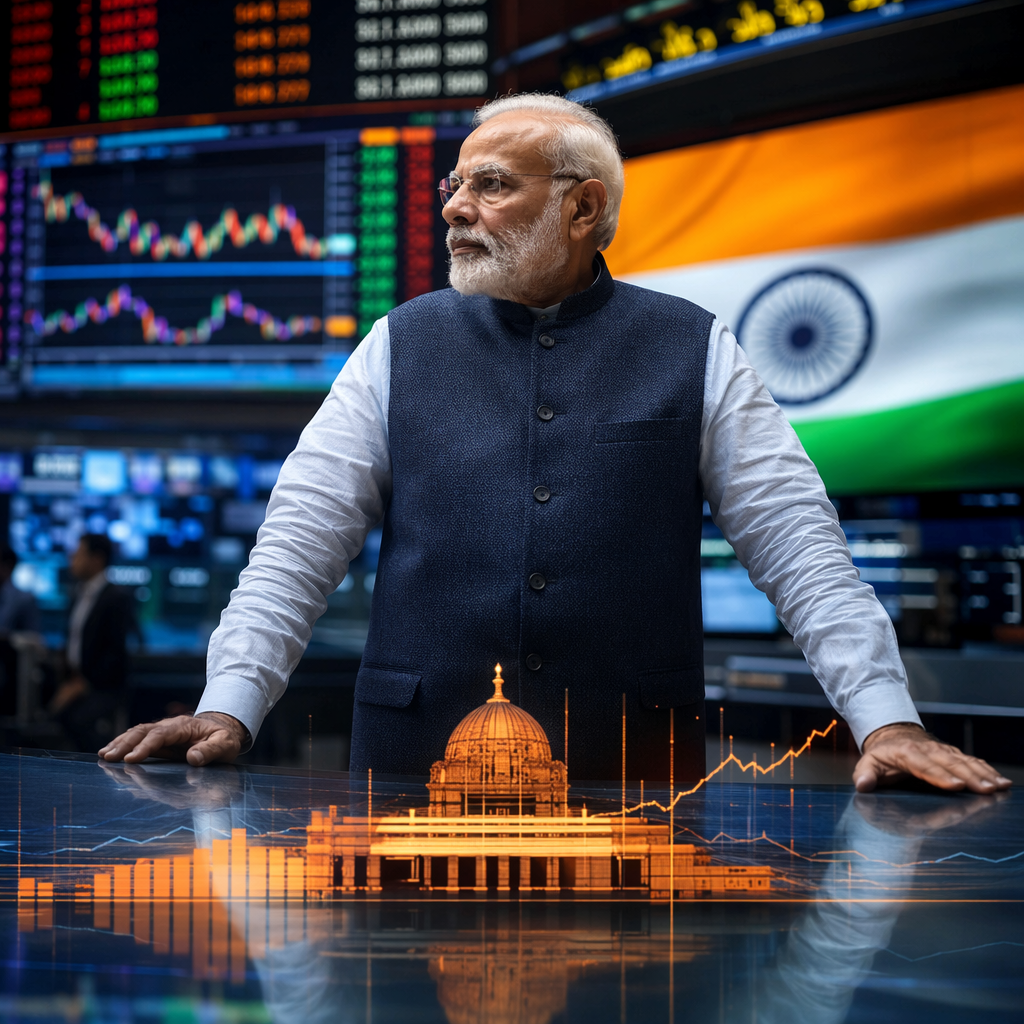
India’s stock market entered 2026 after a decade in which the benchmark indices expanded sharply, foreign investors repeatedly reassessed political risk, and retail participation reached record levels. The period has closely overlapped with Prime Minister Narendra Modi’s tenure, which began in May 2014 and continued after the 2024 general election, when the Bharatiya Janata Party-led National Democratic Alliance returned to office for a third term.
The relationship between a prime minister and the stock market is not direct in the way a government controls tax rates or public spending. Share prices are set by buyers and sellers, and they are influenced by corporate earnings, interest rates, global risk appetite, crude oil prices, currency movement and regulation. However, governments affect market sentiment through fiscal policy, infrastructure spending, privatisation plans, tax rules, capital-market regulation and political stability.
In India’s case, market participants have often tracked announcements linked to the Modi government’s economic programme, including public capital expenditure, manufacturing incentives, digital infrastructure, financial-sector reforms and changes in taxation. Reuters has repeatedly reported that investors viewed policy continuity as a major issue around the 2024 election, particularly because India had become one of the world’s most closely watched equity markets.
2024 election volatility showed political risk in real time
India’s 2024 general election produced one of the clearest examples of how political developments can move markets. On June 4, 2024, when vote counting showed that the BJP would not win a single-party majority, Indian equities fell sharply. Reuters reported that the Nifty 50 and BSE Sensex each dropped by nearly 6% that day, marking their worst single-day fall in about four years. The sell-off reflected concerns about whether coalition politics could affect the pace or structure of economic policy.
The next trading sessions showed a partial recovery after it became clear that the National Democratic Alliance had enough seats to form the government. The Election Commission of India’s 2024 results showed the BJP won 240 seats, below the 272 needed for a Lok Sabha majority, while the NDA crossed the majority threshold with support from allies. Narendra Modi was sworn in for a third term as prime minister on June 9, 2024.
That sequence underlined a basic market fact: investors had not simply priced in the identity of the prime minister; they were also pricing in the size of the mandate and the expected ability of the government to pass legislation, maintain spending priorities and manage fiscal targets.
Benchmark indices after Modi’s third-term mandate
After the election-related fall in June 2024, Indian equities recovered during the year as investors focused again on earnings, domestic flows and expectations of policy continuity. The National Stock Exchange’s Nifty 50 and BSE Sensex both reached record highs in 2024, according to exchange data and Reuters market reports. In September 2024, the Nifty crossed 26,000 for the first time, while the Sensex also traded above 85,000 during the same period, supported by banking, industrial, energy and consumer-linked stocks.
As of 2026, the most important market legacy of the 2024 election period is not one daily fall or one recovery rally. It is that political continuity remained a central part of the investment narrative, while market valuations were still tested by corporate earnings growth, foreign institutional flows and global interest-rate expectations.
India’s equity market capitalisation crossed the $4 trillion mark in 2023 and reached around $5 trillion in 2024, according to exchange data cited by Reuters and market reporting. This placed India among the world’s largest equity markets by market value. The expansion was driven by rising listed-company valuations, new listings, domestic mutual-fund inflows and increased participation from individual investors.
Retail investors became a major market force
One of the most measurable changes during the Modi years has been the rise of retail participation. Official data from the National Securities Depository Ltd. and Central Depository Services Ltd. showed a rapid increase in demat accounts. India crossed 150 million demat accounts in 2024, according to depository data reported by Indian exchanges and financial media. The figure reflected growth from fewer than 40 million accounts around 2020.
Retail participation also increased through mutual funds. The Association of Mutual Funds in India reported that systematic investment plan contributions reached record levels in 2024. Monthly SIP inflows crossed ₹20,000 crore in 2024 and later moved above ₹25,000 crore in 2025, according to AMFI data. Those monthly contributions created a steady domestic source of equity demand, reducing the market’s dependence on foreign portfolio investors compared with earlier cycles.
For policymakers, the rise of household market participation has made capital-market stability a wider economic issue. For investors, it has changed market structure: domestic institutional investors, including mutual funds and insurance companies, have played a larger role in absorbing foreign outflows during periods of global stress.
Government spending and the market link
The Modi government’s fiscal policy has been closely watched by equity investors, especially its capital expenditure targets. In the Union Budget for 2024–25, the Government of India allocated ₹11.11 lakh crore for capital expenditure, equal to about 3.4% of GDP, according to the Ministry of Finance. Infrastructure, railways, roads, defence manufacturing and energy transition companies were among the sectors watched by investors because government orders and public spending can affect revenue visibility.
In the 2025–26 Budget, the government continued to state that capital expenditure and fiscal consolidation were policy priorities. Publicly released Budget documents showed the government setting a fiscal-deficit path while maintaining large infrastructure spending. Equity analysts and Reuters reports noted that investors tracked whether coalition politics after the 2024 election would lead to a shift from capital expenditure toward welfare spending. Budget documents showed that the government retained a focus on infrastructure, while also announcing tax measures and social-sector allocations.
Several listed sectors have been tied to these policy areas:
- Infrastructure and capital goods: affected by central and state government project awards.
- Public-sector banks: influenced by credit growth, asset quality and government ownership policy.
- Defence manufacturers: linked to domestic procurement and indigenisation targets.
- Railway-linked companies: affected by railway capex and rolling-stock orders.
- Renewable energy and power: influenced by solar, transmission and green-energy targets.
These links do not mean that all companies in these sectors rise because of government policy. Stock performance depends on valuations, execution, debt levels, margins and investor expectations. However, government spending data provides a factual basis for why investors closely monitor policy announcements from the prime minister, the Cabinet and the Ministry of Finance.
Foreign investors: confidence and caution
Foreign portfolio investors have remained important to India’s stock market, even as domestic flows have grown. In 2024, foreign investors bought and sold Indian equities in response to election risk, U.S. interest-rate expectations, oil prices, the rupee and comparative valuations in other emerging markets. Reuters reported heavy foreign selling around election uncertainty in 2024, followed by renewed buying in later periods when political continuity and economic growth expectations were reassessed.
As of 2026, India’s weight in global emerging-market indices and its relatively high valuation compared with several peers remain important factors for foreign investors. MSCI index changes, passive inflows, sovereign-bond index inclusion and rupee stability have all influenced how global funds allocate to India. The market’s reaction to political events during Modi’s third term has therefore taken place within a larger global investment cycle, not only within domestic politics.
Economic growth data underpins market expectations
Stock markets typically price future earnings, but macroeconomic growth data shapes those expectations. India’s real GDP growth was 8.2% in fiscal year 2023–24, according to the National Statistical Office. The Reserve Bank of India and government agencies later projected India to remain one of the faster-growing major economies in 2024–25 and 2025–26, though quarterly growth varied.
The International Monetary Fund and World Bank have also published forecasts showing India among the fastest-growing large economies during this period. Such data has supported the investment case for Indian equities, although high growth does not automatically guarantee stock-market gains. Inflation, interest rates, corporate profits and valuations still determine returns.
The Reserve Bank of India kept the policy repo rate at 6.5% for an extended period through 2024, according to RBI monetary policy statements. The interest-rate environment mattered for equities because higher rates can reduce valuation multiples, while stable rates can support credit growth and financial-sector earnings. Investors also tracked inflation, which influences household consumption and company input costs.
Taxation and regulation affected investor behaviour
The government’s approach to capital-gains taxation, securities transaction tax, listing rules and investor protection has also affected market behaviour. In the July 2024 Budget, the government announced changes to capital-gains tax treatment and raised the securities transaction tax on certain futures and options transactions, according to the Ministry of Finance. The changes were relevant because India had seen rapid growth in derivatives trading by retail participants.
The Securities and Exchange Board of India, the market regulator, also increased scrutiny of derivatives risk and investor protection. SEBI data and public statements in 2024 and 2025 highlighted concerns that a large share of individual traders in equity derivatives incurred losses. This became an important regulatory issue because the growth of retail accounts was accompanied by growth in high-risk trading products.
For the stock market, these measures showed that policy under the Modi government was not limited to growth and infrastructure. It also included attempts to manage market risk, tax speculative activity and strengthen regulatory oversight.
Public-sector companies and divestment expectations
Public-sector companies have been another area where the stock market has tracked government policy. During Modi’s tenure, investors have followed privatisation, disinvestment and dividend decisions in sectors such as energy, finance, insurance, railways and defence. Some public-sector stocks rose significantly in 2023 and 2024 as investors priced in higher capital expenditure, stronger balance sheets, larger dividends and improved profitability.
However, divestment targets have often differed from actual proceeds. Government Budget documents show that non-debt capital receipts and disinvestment have varied from year to year, depending on market conditions and policy decisions. This distinction matters because market expectations around privatisation can change quickly if official targets are revised or strategic sales are delayed.
What can be attributed to PM Modi—and what cannot
It is factually accurate to say that India’s stock market expanded substantially during Narendra Modi’s tenure and that investors have responded to policy signals from his government. It is also factual that the 2024 election result caused a sharp market reaction when the BJP fell short of a single-party majority, followed by stabilisation after the NDA formed the government.
It would not be accurate to attribute all market gains or losses only to the prime minister. Indian equities during 2024–2026 were also influenced by U.S. Federal Reserve policy, global technology valuations, crude oil prices, geopolitical tensions, corporate earnings, the rupee, domestic inflation, monsoon conditions and investor flows. Reuters market reports during this period repeatedly linked Indian market movements to both domestic political developments and global financial conditions.
As of 2026, the data shows three clear points. First, political continuity under PM Modi has been a major factor watched by investors. Second, domestic savings through mutual funds and demat accounts have become more important to market depth. Third, policy areas such as capital expenditure, taxation, regulation and public-sector management remain central to how the stock market evaluates the government’s economic direction.
The market’s judgment is updated every trading day. Under Modi’s third term, investors continue to measure announcements against earnings, fiscal data and execution. That makes the connection between PM Modi and the stock market significant, but not absolute: policy can shape expectations, while prices ultimately reflect a wider set of economic and financial facts.
Sources: Reuters, Government releases, publicly available data.
Comments
Post a Comment