Nintendo Switch 2: confirmed facts and market context
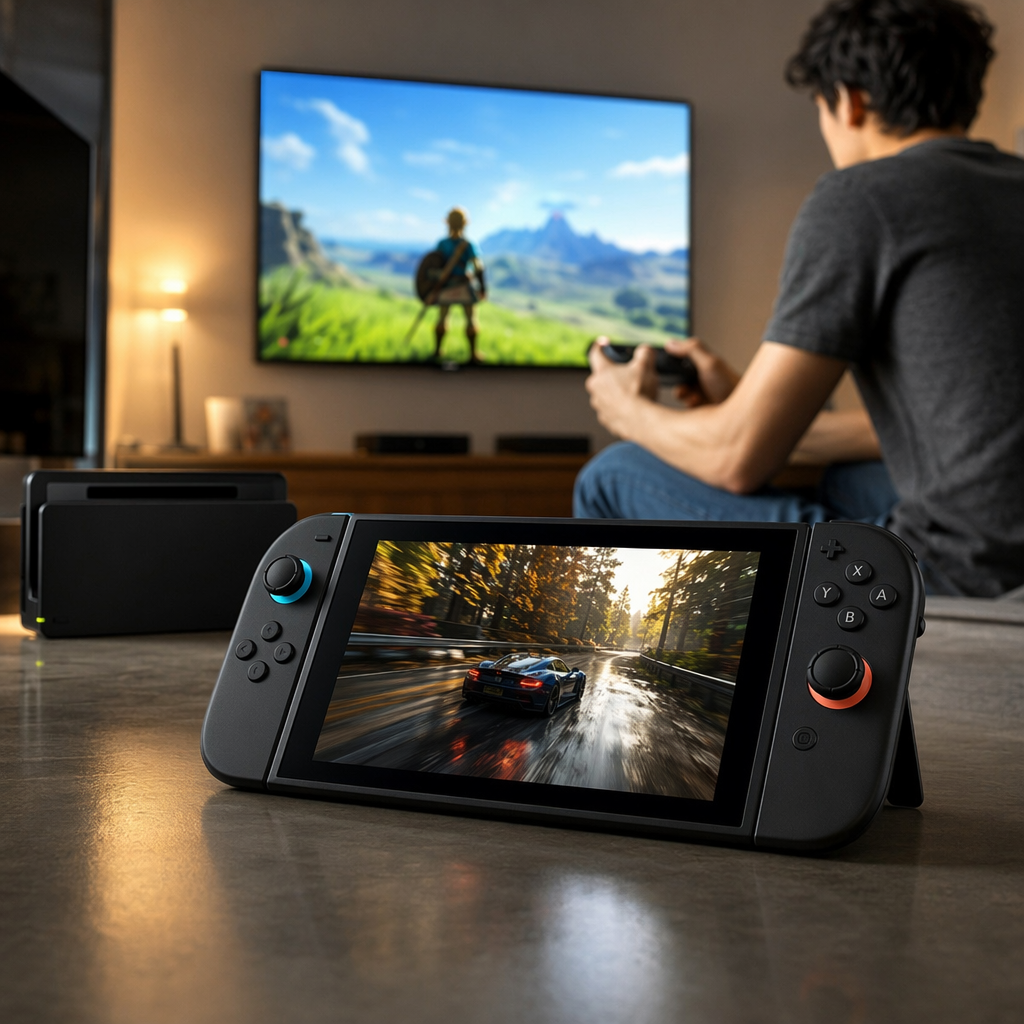
Nintendo began selling the Nintendo Switch 2 on June 5, 2025, at a U.S. suggested retail price of $449.99, according to Nintendo’s official product information and launch announcements. The release followed a record-setting run for the original Nintendo Switch, which Nintendo reported had sold more than 141 million units worldwide by 2024, making it one of the best-selling game consoles in history.
The Switch 2 is Nintendo’s first new flagship console since the original Switch launched in March 2017. Its arrival came at a time when the global video game hardware business was under pressure from higher component costs, exchange-rate movements, and slower console sales in some mature markets. Reuters reported in 2024 that investors and analysts were closely watching Nintendo’s next hardware cycle because the Switch, despite its unusually long commercial life, had entered its eighth year on the market.
As of 2026, the Switch 2 is positioned as Nintendo’s current-generation hybrid console: a device that can be used as a handheld system, connected to a television through a dock, and paired with detachable Joy-Con controllers. Nintendo’s public materials describe the system as backward compatible with most physical and digital Nintendo Switch games, while also supporting new Switch 2 software built for the upgraded hardware.
Launch date, price, and first confirmed markets
Nintendo confirmed the Switch 2 through official announcements in 2025 and scheduled its global launch for June 5, 2025. In the United States, Nintendo listed the console at $449.99. A bundle including Mario Kart World was listed at $499.99. In Japan, Nintendo announced a domestic-language model priced at 49,980 yen, while a multi-language version was priced higher for broader regional use.
Reuters reported in 2025 that Nintendo’s pricing drew attention because the original Switch launched in 2017 at $299.99 in the United States. The difference reflected a changed cost environment for consumer electronics, including inflation, supply-chain costs, and stronger technical specifications.
The Switch 2 launch also came during a period of active trade-policy discussion. U.S. government tariff announcements in 2025 affected multiple consumer-electronics categories, and Reuters reported that companies selling hardware in the United States were assessing the financial effect of import duties and manufacturing locations. Nintendo’s public pricing information provided the baseline for consumers, while the company’s financial filings were used by investors to monitor any cost impact.
Key hardware changes Nintendo confirmed
The Switch 2 keeps the basic hybrid design of the 2017 system but adds a larger screen, more powerful internal components, revised controllers, and updated connectivity. Nintendo’s official specifications list a 7.9-inch LCD screen with 1080p resolution in handheld mode. The original Switch used a 6.2-inch LCD screen at 720p, while the Switch OLED model used a 7.0-inch OLED panel.
Nintendo also confirmed support for up to 4K output when docked on compatible televisions and software, as well as higher frame-rate options depending on the game. The company’s technical materials state that the console supports HDR and variable refresh-rate functions in supported display modes.
The new Joy-Con 2 controllers attach magnetically, replacing the rail system used by the original Switch. Nintendo also introduced a dedicated C button, tied to GameChat, the company’s voice and video chat feature for Switch 2 users. GameChat was described by Nintendo as an integrated communication tool that can be used with a compatible camera accessory and Nintendo Switch Online account requirements.
Publicly listed specifications include:
- Launch date: June 5, 2025, according to Nintendo.
- U.S. price: $449.99 for the standard console and $499.99 for the Mario Kart World bundle.
- Display: 7.9-inch LCD screen with 1080p handheld resolution.
- Docked output: up to 4K resolution on compatible software and displays.
- Storage: 256GB internal storage, according to Nintendo’s specifications.
- Compatibility: support for most Nintendo Switch physical and digital games, subject to software-specific exceptions.
The internal storage figure is a major increase over the original Switch, which launched with 32GB of internal storage. Nintendo’s published specifications list 256GB for Switch 2, reflecting the larger size of modern game files and the growth of digital distribution.
Software lineup and Nintendo’s first-party strategy
Nintendo’s hardware launches have historically depended on first-party software, and the Switch 2 launch followed that model. Nintendo announced Mario Kart World as a major launch title and used it as the pack-in game for a higher-priced hardware bundle. The title was presented as a new entry in one of Nintendo’s largest franchises.
Nintendo also announced Switch 2 versions or editions for selected existing Switch games, including upgrades designed to use the new system’s display and performance features. The company said compatibility would cover most existing Switch software, but it also published guidance that some titles may not be fully compatible or may require updates.
That compatibility decision is commercially important. By 2024, Nintendo had reported a large installed base for the original Switch family. According to Nintendo’s financial materials, more than 1.2 billion units of Switch software had been sold worldwide by 2024. Carrying much of that library forward reduces the break between generations for existing customers and gives new buyers immediate access to a large catalog.
Reuters and other business news outlets noted in 2024 and 2025 that backward compatibility was a key investor focus. A clean transition matters because Nintendo’s earnings are heavily tied to first-party software, licensing, and digital sales as well as hardware margins.
Sales context: why the Switch 2 launch matters
The original Switch had an unusually long market cycle. Launched in March 2017, it was still selling in meaningful numbers in 2024. Nintendo’s financial reports showed that the Switch family had passed 141 million hardware units worldwide by 2024. That placed it near the lifetime totals of Sony’s PlayStation 2 and Nintendo’s own DS family, both of which are among the highest-selling gaming devices ever released.
However, Nintendo’s own reporting also showed that Switch hardware sales had slowed as the console aged. For the fiscal year ended March 2024, Nintendo reported Switch hardware sales of 15.70 million units. That was lower than the pandemic-era peak, when demand for home entertainment and titles such as Animal Crossing: New Horizons drove major sales growth.
For the fiscal year ending March 2025, Nintendo issued more cautious hardware forecasts as it prepared the market for the successor system. Reuters reported in 2024 that Nintendo shares moved in response to news and expectations about the next console, showing how closely investors linked the company’s future growth to the Switch 2 transition.
As of 2026, the Switch 2 is therefore not only a new consumer device but also the center of Nintendo’s next earnings cycle. Hardware sales, software attach rates, Nintendo Switch Online subscriptions, and digital-store spending are all measurable factors in the company’s performance.
Japan, the United States, and global console demand
Nintendo is headquartered in Kyoto, Japan, but the Switch 2 was designed for a global market. Its key regions include Japan, North America, and Europe. The company reports regional sales data in its financial results, while national agencies provide broader economic context.
In Japan, the Ministry of Economy, Trade and Industry publishes data on industrial production and electronics-related sectors, while the Ministry of Internal Affairs and Communications reports inflation and household-spending indicators. These government datasets are relevant because they influence domestic consumer-electronics pricing and demand conditions, though Nintendo’s sales are reported separately in company filings.
In the United States, official data from the Bureau of Labor Statistics showed that consumer prices remained above pre-2020 trend levels in 2024 and 2025. Higher retail prices for entertainment hardware were therefore viewed in the context of broader inflation. The Switch 2’s $449.99 U.S. price was $150 higher than the original Switch launch price in 2017, a concrete difference for households comparing upgrade costs.
Exchange rates also mattered. Reuters reported repeatedly in 2024 and 2025 that the Japanese yen traded at historically weak levels against the U.S. dollar during parts of that period. A weaker yen can raise the yen value of overseas revenue for Japanese exporters, but it can also affect imported component costs and pricing decisions.
Online services and digital revenue
The Switch 2 also continues Nintendo’s push into recurring digital revenue. Nintendo Switch Online, the paid subscription service used for online play, cloud saves, classic game libraries, and expansion content, remains part of the platform. Nintendo has not described the Switch 2 as a separate online ecosystem; instead, it is connected to the same Nintendo Account structure.
This matters because digital sales are a larger part of Nintendo’s business than they were during older hardware cycles. Nintendo’s financial reports in 2024 showed continued revenue from downloadable software, add-on content, and subscriptions. The Switch 2 adds new features such as GameChat, which Nintendo links to online communication and compatible accessories.
Digital distribution also affects storage needs. Nintendo’s confirmation of 256GB internal storage is significant because large downloadable games and expansion data can quickly exceed the 32GB capacity of the original 2017 model. The Switch 2 also supports expandable storage through compatible memory cards, according to Nintendo’s specifications.
Backward compatibility and consumer protection issues
Backward compatibility has a practical consumer-protection dimension. Buyers of digital games want to know whether past purchases remain usable. Nintendo stated that most Nintendo Switch games, both physical and digital, can be played on Switch 2. The company also warned that some software may be incompatible or may not work exactly as it did on the original system.
This approach is consistent with how console makers typically handle generational transitions, but the details matter. Nintendo published compatibility information and advised users to check official support pages for game-specific issues. For households with large Switch libraries, those official notices are more reliable than retailer descriptions or social-media claims.
Consumer agencies in major markets, including the U.S. Federal Trade Commission and European national consumer authorities, generally require clear advertising and accurate product information. While those agencies do not approve console claims before launch, their public rules on truthful marketing apply to consumer electronics, subscriptions, and digital purchases.
Competition with PlayStation, Xbox, PC, and mobile games
The Switch 2 enters a gaming market that is broader than the traditional console race. Its competitors include Sony’s PlayStation 5, Microsoft’s Xbox Series X and Series S, PC handhelds, smartphones, and cloud-gaming services. Reuters reported in 2024 that console makers were operating in a market affected by slowing hardware demand after the pandemic-era surge.
Nintendo’s strategy remains different from Sony’s and Microsoft’s. The Switch 2 is built around portable play, family-oriented franchises, and exclusive software such as Mario, Zelda, Pokémon, Animal Crossing, and Splatoon. Those franchises are owned or controlled by Nintendo and its partners, which allows the company to sell hardware and software as a connected ecosystem.
At the same time, the Switch 2’s higher performance and backward compatibility are designed to make it more attractive to third-party publishers than the original Switch was at launch. Nintendo’s 2025 presentations included third-party software support, although the long-term size of that catalog depends on publisher decisions and sales performance.
What is confirmed as of 2026
As of 2026, several facts about Nintendo Switch 2 are established through Nintendo announcements, company filings, Reuters reporting, and public economic data. The console launched on June 5, 2025. Its U.S. price was listed at $449.99, with a $499.99 bundle including Mario Kart World. It has a 7.9-inch 1080p handheld screen, supports up to 4K output when docked, includes 256GB of internal storage, and uses redesigned magnetic Joy-Con 2 controllers.
The system follows a predecessor that had sold more than 141 million units worldwide by 2024. Nintendo reported 15.70 million Switch hardware units sold in the fiscal year ended March 2024, showing that the older platform remained large but was past its peak. The company also reported more than 1.2 billion Switch software units sold by 2024, giving the Switch 2 a large legacy library through backward compatibility.
The business environment around the launch includes inflation, exchange-rate movements, tariff discussions, and a global games market that has normalized after the pandemic-era boom. Those factors are documented in Reuters coverage and government economic releases. They do not change the confirmed specifications of the Switch 2, but they help explain why its price, supply, and sales trajectory are being watched closely by consumers, developers, and investors.
Sources: Reuters, Government releases, publicly available data.
Comments
Post a Comment