Aadhaar in 2026: India’s Biometric ID System at National Scale
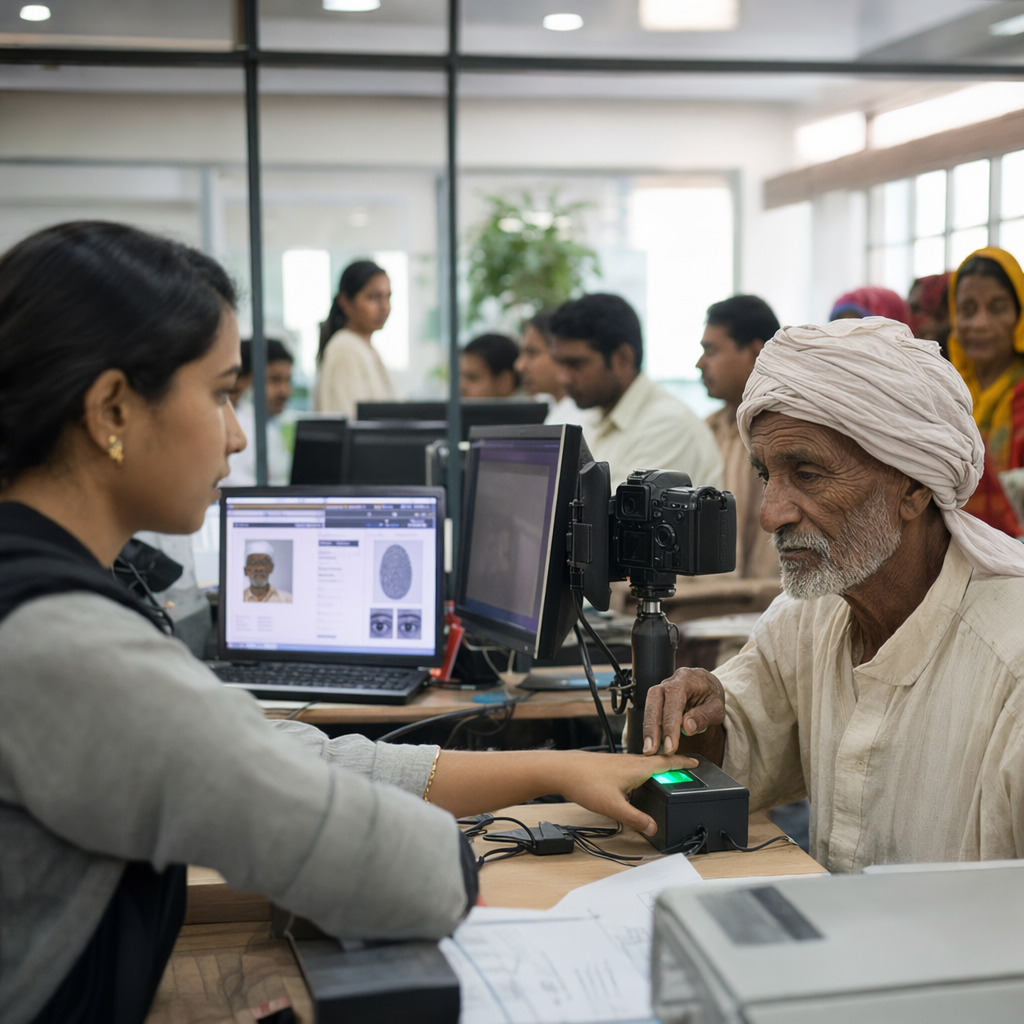
As of 2026, Aadhaar remains one of the world’s largest digital identity programmes, used across welfare delivery, banking, telecom verification, tax administration and online authentication in India. The Unique Identification Authority of India, or UIDAI, issues Aadhaar numbers under the Ministry of Electronics and Information Technology, linking a 12-digit identity number to demographic and biometric information submitted by residents.
The scale of the system is unusually large by international standards. UIDAI’s publicly available data show Aadhaar enrolment covering more than 1.38 billion Aadhaar numbers by the mid-2020s, reflecting near-universal coverage among India’s resident population. India’s population was estimated at more than 1.4 billion by the United Nations in 2024, making Aadhaar a core public digital identity infrastructure for a country of continental size.
Aadhaar is not proof of citizenship. The Aadhaar Act, 2016 defines it as a unique identity number issued to residents, based on biometric and demographic data, for the purpose of establishing identity. The distinction is important because Aadhaar is widely used in official processes, but it does not itself determine nationality, voting rights or legal citizenship status.
What Aadhaar Records and How It Is Used
Aadhaar enrolment records basic demographic details, including name, date of birth or age, gender and address. It also records biometric data, including fingerprints, iris scans and a photograph. UIDAI assigns each resident a 12-digit number after de-duplication, a process intended to prevent more than one Aadhaar number being issued to the same person.
In everyday use, Aadhaar supports identity verification through online authentication, offline QR code-based verification, one-time password verification and biometric authentication. The system is used by government departments, banks, telecom firms and other regulated service providers, subject to rules under the Aadhaar Act and related regulations.
Government agencies have used Aadhaar to support the delivery of subsidies and benefits under the Direct Benefit Transfer system. The Government of India has consistently described Aadhaar-based identification as a tool for reducing duplication in beneficiary lists and improving targeted delivery. According to the Direct Benefit Transfer Mission’s public dashboard, DBT has covered hundreds of central government schemes across ministries in the 2024–2026 period, with Aadhaar-enabled bank account linkage playing a key operational role in many programmes.
Key 2024–2026 Data Points
Several official and publicly reported figures show how deeply Aadhaar is embedded in India’s administrative and digital economy systems. The following figures are drawn from UIDAI, Government of India dashboards, Reserve Bank of India materials and publicly available reporting.
- More than 1.38 billion Aadhaar numbers had been generated by 2024–2025, according to UIDAI’s public dashboard and releases.
- India’s population was estimated at over 1.4 billion in 2024, according to United Nations population estimates, placing Aadhaar coverage close to nationwide scale among residents.
- UIDAI said in 2024 that Aadhaar authentication transactions had crossed tens of billions cumulatively, reflecting use in banking, welfare and service verification.
- The Aadhaar Enabled Payment System, or AePS, continued to process financial transactions in 2024 and 2025, according to National Payments Corporation of India public product data, particularly supporting banking access through micro-ATMs and business correspondents.
- Direct Benefit Transfer continued to cover hundreds of central schemes in 2024–2026, according to the Government of India’s DBT Mission dashboard.
- UIDAI continued its free online document update facility into 2024 and 2025 through official announcements, encouraging residents to update proof of identity and proof of address documents where necessary.
Aadhaar, Welfare Delivery and Direct Benefit Transfer
Aadhaar’s most significant public-sector role is in welfare delivery. Under DBT, subsidies and benefits are transferred directly into bank accounts. Aadhaar can be used to identify beneficiaries, link welfare records and support Aadhaar Payment Bridge transactions where bank accounts are mapped to Aadhaar numbers.
The Government of India has reported large cumulative savings from DBT and digitised beneficiary management over the past decade. While the government attributes savings to reduced duplication, better targeting and removal of ineligible or duplicate entries, independent researchers have noted that different schemes use different methods, and savings estimates can depend on methodology. For factual reporting, it is therefore important to attribute such claims directly to government releases rather than present them as independently verified universal outcomes.
In 2024–2026, Aadhaar-based verification continued to be relevant for major welfare and subsidy schemes, including cooking gas subsidy administration, rural employment-related payments, pension distribution, food subsidy targeting and scholarships. In many schemes, Aadhaar seeding and bank account validation are administrative requirements, although the Supreme Court of India and government notifications have also shaped the conditions under which Aadhaar can be made mandatory.
Legal Framework and the Supreme Court Position
The main law governing Aadhaar is the Aadhaar (Targeted Delivery of Financial and Other Subsidies, Benefits and Services) Act, 2016. The Act sets out UIDAI’s powers, enrolment rules, authentication methods, data protection duties and penalties for misuse.
In September 2018, a Constitution Bench of the Supreme Court of India upheld the constitutional validity of Aadhaar by a majority judgment but limited its mandatory use in some private-sector contexts. The Court allowed Aadhaar requirements for welfare benefits funded from the Consolidated Fund of India and for Permanent Account Number, or PAN, linking under income-tax law. It struck down provisions that allowed broad private-sector use of Aadhaar authentication without adequate legal backing.
That judgment remains a central legal reference point for Aadhaar policy in 2026. Since then, the government has amended rules and introduced additional frameworks for authentication and offline verification. Financial-sector and telecom use of Aadhaar has continued under specific legal and regulatory conditions, including customer consent-based processes where applicable.
Aadhaar and Banking Access
Aadhaar is closely connected to India’s financial inclusion infrastructure. The Jan Dhan-Aadhaar-Mobile framework, often referred to as JAM, links bank accounts, Aadhaar and mobile numbers to support benefit transfer and low-cost digital verification.
The Aadhaar Enabled Payment System allows bank customers to carry out transactions using Aadhaar authentication through business correspondents. This can include cash withdrawal, balance enquiry and remittance services, subject to bank and NPCI rules. The system has been especially relevant in rural and semi-urban areas where branch access is limited.
The Reserve Bank of India and NPCI have repeatedly highlighted the role of digital payment rails in expanding access to formal finance. However, regulators have also warned about fraud risks, cyber risks and the need for customer awareness. In Aadhaar-linked banking, common risk areas include biometric misuse, social engineering, unauthorised linking, and fraudulent withdrawals through compromised authentication points.
Privacy, Data Protection and Security Issues
Aadhaar’s scale has made privacy and data security central policy concerns. UIDAI maintains that core biometric information is stored in a secure central identities data repository and is not shared during authentication. Authentication responses generally confirm whether submitted details match the records, rather than revealing the biometric database itself.
At the same time, public debate has focused on risks such as excessive data collection by service providers, improper storage of Aadhaar numbers, exposure of beneficiary lists on public websites, and misuse of photocopies or electronic copies of Aadhaar documents. Government departments have issued advisories over the years asking agencies not to publicly display Aadhaar numbers and to follow data minimisation principles.
India’s Digital Personal Data Protection Act, 2023 created a broader legal framework for personal data processing. As of 2026, Aadhaar-related processing remains governed by the Aadhaar Act, UIDAI regulations and the wider data protection framework as it is implemented through government notifications and rules. The practical effect depends on notified rules, compliance systems and enforcement actions.
Updating Aadhaar Details
UIDAI has repeatedly advised residents to keep Aadhaar details current, especially if the number was issued many years earlier and identity or address documents have not been updated. Document updates can help reduce verification failures when residents use Aadhaar for banking, government benefits, telecom connections or official services.
UIDAI’s official portal allows certain updates online, while biometric updates and some demographic corrections require visits to authorised Aadhaar enrolment or update centres. Children enrolled before the age of five are required to update biometrics after reaching the prescribed age, because early childhood biometrics are not considered permanent for long-term identity authentication.
Residents can also use masked Aadhaar, offline Aadhaar XML and QR code-based verification where accepted. Masked Aadhaar displays only the last four digits of the Aadhaar number, reducing unnecessary disclosure of the full number. UIDAI has advised residents to avoid sharing Aadhaar copies indiscriminately and to use official channels for downloads and verification.
Aadhaar in Tax, Telecom and Digital Services
Aadhaar is linked to the Permanent Account Number system under Indian income-tax law. PAN-Aadhaar linking has been used to reduce duplication in tax records and improve identity consistency across tax filings. The Income Tax Department has issued several deadlines and notices over the years regarding PAN-Aadhaar linking, with consequences for inoperative PANs where linking requirements are not met, subject to exemptions and official notifications.
In telecom, Aadhaar-based e-KYC was widely used before the 2018 Supreme Court judgment restricted compulsory private use. Subsequent processes have allowed regulated and consent-based verification methods under approved legal frameworks. Telecom operators may use alternative documents and digital verification methods depending on Department of Telecommunications rules in force.
Aadhaar authentication and offline verification are also used in digital public infrastructure such as DigiLocker, government service portals and state-level citizen services. These integrations are intended to reduce repeated document submission, but they also require compliance with consent, purpose limitation and data security rules.
Exclusion and Authentication Failures
One of the most closely watched issues is whether Aadhaar-based systems exclude eligible people from services. Authentication can fail for several reasons, including worn fingerprints, poor connectivity, incorrect data seeding, mismatch in names or dates of birth, inactive bank mapping, or device-level errors.
Government guidelines for welfare schemes generally require exception-handling mechanisms so that eligible beneficiaries are not denied benefits solely because Aadhaar authentication fails. These mechanisms may include alternative identity documents, manual verification, one-time password authentication, iris authentication or local administrative approval.
Courts and regulators have emphasised that identity systems should not block access to legally due welfare benefits. For that reason, Aadhaar implementation is not only a technology matter but also an administrative process involving field staff, grievance redressal, local records and banking infrastructure.
What Residents Should Know in 2026
As of 2026, Aadhaar is widely used but should be treated as sensitive identity information. Residents should download Aadhaar only from UIDAI’s official website or mAadhaar app, check authentication history where needed, lock or unlock biometrics through UIDAI services, and use masked Aadhaar when the full number is not required.
For official services, residents should verify whether Aadhaar is mandatory, optional or one of several accepted identity documents. The answer depends on the scheme, legal basis and service provider. Government welfare schemes may require Aadhaar where permitted by law, while many private services must follow consent-based or alternative verification rules.
Aadhaar’s importance in India’s public systems is clear from its continuing role in welfare payments, banking access, tax identity and digital verification. Its future use will depend on statutory safeguards, regulatory compliance, technology reliability and the ability of agencies to ensure that identity verification does not prevent eligible people from receiving services.
Sources: Reuters, Government releases, publicly available data.
Comments
Post a Comment